Introduction
A Basic Loan Calculator is really helpful when you need to know what a loan will cost you before you agree to it. If you are buying a car or taking out a loan for yourself or for your home it is good to know how much you will pay each month and how interest you will pay in total. This will make it easier for you to plan your money.The Basic Loan Calculator is, for people who are borrowing money students, homeowners and anyone who is looking at loan options and wants to know the exact numbers.
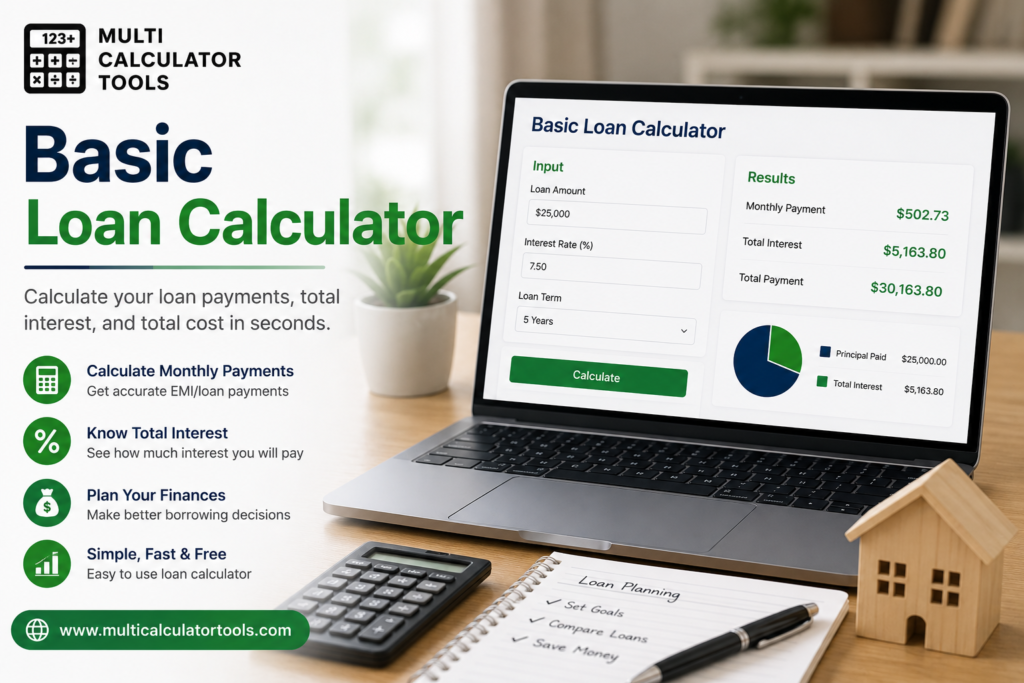
To use the Basic Loan Calculator you just need to enter the amount of the loan the interest rate and how long you will take to pay it back. Then you will see how much your monthly payment will be, how interest you will pay and the total cost of the loan. You will get this information quickly.
Quick Answer
A basic loan calculator helps you figure out how much you will pay each month for a loan. It also tells you the interest you will pay and the total amount you will pay back. This is based on the amount of money you borrow the interest rate and how long you have to pay back the loan. The loan calculator uses math to give you a good idea of what to expect before you actually get a loan.
What Is a Basic Loan Calculator?
A Basic Loan Calculator is an useful thing that helps you figure out how much you will pay each month and how much the loan will cost you in total. It uses three things to do this: the amount of money you want to borrow the interest rate and how long you want to take to pay back the loan. The Basic Loan Calculator then uses these things to show you how much you will pay each month and over the time you are paying back the Basic Loan.
People who want to borrow money use this tool to figure out how much a loan will really cost them before they decide to get it. Of just trusting what the lender tells you a calculator lets you try out different loan amounts and interest rates and repayment periods all at the same time so you can look at different options and see how they affect how much money you have to pay every month. Loan calculators are very helpful, for borrowers because they can help you understand loans and make a decision. When you use a loan calculator you can see what a loan will cost you over time which’s important for borrowers to know.
How Does the Basic Loan Calculator Work?
The calculator works by using math to figure out your loan payments. It looks at how much you borrow the interest rate and how long you have to pay it back. Then it calculates a fixed amount you need to pay each month to clear the loan by the end of the term.Here’s what each input and output means:
- When you get a loan the loan amount is the amount of money you are borrowing before any interest is added to it.
- The interest rate is what the lender charges you every year. They use this to figure out the monthly interest rate so they can calculate your payments.
- The loan term is how long you have to pay back the loan and people usually say this in months or years.
- To calculate your payment the lender uses the loan amount the monthly interest rate and the total number of payments you will make so each monthly payment will cover some of the loan amount and some of the interest, on the loan amount.
How to Use the Basic Loan Calculator
- Enter how money you want to borrow.
- Enter the interest rate.
- Select how months or years you have to pay back the loan.
- Choose how you want to make payments.
- Click Calculate.
- Check how much you have to pay each month.
- See how interest you pay over the whole loan period.
- Try loan options by changing the amount interest rate or loan term.
Factors That Affect Loan Payments
Several variables directly influence how much you’ll pay each month and overall. The table below breaks down the most significant ones.
| Factor | Impact on Loan Payment | Example |
| Loan Amount | Larger loan amounts increase both monthly payments and total interest | Borrowing $20,000 instead of $10,000 roughly doubles the payment |
| Interest Rate | Higher rates increase the interest portion of each payment | A 9% rate costs noticeably more than a 5% rate on the same loan |
| Loan Term | Longer terms lower monthly payments but increase total interest paid | A 60-month term has lower payments than a 36-month term, but costs more overall |
| Payment Frequency | More frequent payments (biweekly vs monthly) can reduce total interest slightly | Biweekly payments add up to one extra payment per year |
| Extra Payments | Additional principal payments shorten the loan and reduce total interest | Paying $100 extra per month can cut months off the loan term |
| Fixed vs Variable Rate | Variable rates can increase or decrease payments over time, unlike fixed rates | A variable-rate loan may rise if market interest rates increase |
| Credit Score | Higher credit scores typically qualify for lower interest rates | A strong credit score may secure a rate several points lower |
| Loan Fees | Origination fees and closing costs add to the true cost of borrowing | A 2% origination fee adds directly to upfront borrowing costs |
Benefits of Using a Basic Loan Calculator
- When it comes to loans you need to think about your budget. You have to see how a loan payment fits into your expenses before you commit to it.
- This means you have to look at your money and think about what you can afford.
- Comparing loan offers is also very important. You should look at rates and terms side by side to find the loan that is best for you.
- You need to understand how much it is going to cost you to borrow money. This means you need to get a picture of the total interest you will pay not just the monthly payment.
- You can plan your payments by adjusting the loan amount or term until the payment fits your budget comfortably.
- Making decisions can help you save money. For example you can see how a shorter term or better rate can really reduce the cost of the loan.
- It is an idea to prepare before you apply for a loan. This means you should walk into conversations, with lenders with expectations and a stronger position to negotiate.
Tips to Reduce Loan Costs
- Improve your credit score before applying because better scores usually get interest rates.
- When looking for a loan compare offers, from lenders instead of going with the first one.
- If you can afford it choose a loan with a term since it means you pay less interest overall.
- If possible make a down payment so you borrow less money.
- Try to pay extra towards the loan amount whenever you can to pay off the loan faster and save on interest.
- Read the loan terms carefully before signing to avoid fees.
- If interest rates go down or your credit score gets much better think about refinancing your loan.
Frequently Asked Questions
What is a Basic Loan Calculator? A Basic Loan Calculator is a tool that estimates your monthly payment, total interest, and total repayment cost based on the loan amount, interest rate, and term you enter. It uses standard amortization formulas to give borrowers a quick, clear estimate before committing to a loan.
How are monthly loan payments calculated? Monthly payments are calculated using the loan amount, the monthly interest rate, and the total number of payments over the loan term. The formula ensures each payment covers both interest and a portion of the principal, fully repaying the loan by the end of the term.
Does a loan calculator include interest? Yes, a loan calculator factors interest into every monthly payment, along with showing total interest paid over the life of the loan. This lets you see not just what you’ll pay each month, but the full cost of borrowing once interest is added to the principal.
Can I calculate personal loans? Yes, the calculator works for personal loans by using the same core inputs: loan amount, interest rate, and term. Personal loans typically use fixed rates and fixed terms, making them well-suited to standard amortization-based calculations like this one.
Conclusion
To manage your money better you need to see how a loan payment will fit into your expenses before you decide to take out a loan.When you are looking at loan offers you should compare the rates and terms of each loan to find the one that is the most affordable.You should understand how much it will cost you to borrow money, including the interest you will pay not just the amount of your monthly payment.When you are planning your payments you can adjust the amount you borrow or the length of the loan until the payment is comfortable for you.
You can save money by making decisions like choosing a shorter loan term or a better interest rate, which can really reduce the total cost of the loan.Before you apply for a loan you should prepare yourself by understanding what you can afford and what you can negotiate with the lender.