Aggregate Abrasion Value Calculator
Los Angeles Abrasion Test — wear resistance of road stone (IS 2386 Part 4)
ℹ️ Max permissible: 40% for WBM base, 35% for DBM, 30% for bituminous concrete wearing course.
The durability of aggregate has an impact on how long roads and runways and concrete structures can last when they are used by traffic and when they have to carry heavy loads.The Aggregate Abrasion Value Calculator is a tool that helps engineers and contractors and material testing labs to find out how well an aggregate sample can resist wear and tear.This is done by looking at the weight loss of the sample after it has been tested for abrasion.It can help them to do their jobs better.You can use the Aggregate Abrasion Value Calculator to calculate your Aggregate Abrasion Value this will save you a lot of time and effort.
Quick Answer Box
The Aggregate Abrasion Value Calculator finds out how much an aggregate sample wears out during a test. To calculate it you take the weight loss divide it by the weight and then multiply by 100.A lower Aggregate Abrasion Value means the aggregate is harder and can resist wear.
What Is an Aggregate Abrasion Value Calculator?
An Aggregate Abrasion Value Calculator helps figure out how much an aggregate sample wears down during a test. This test shows if the aggregate can resist wear and tear.The calculator turns lab weight measurements into a value.
Formula Used by the Aggregate Abrasion Value Calculator
Formula:
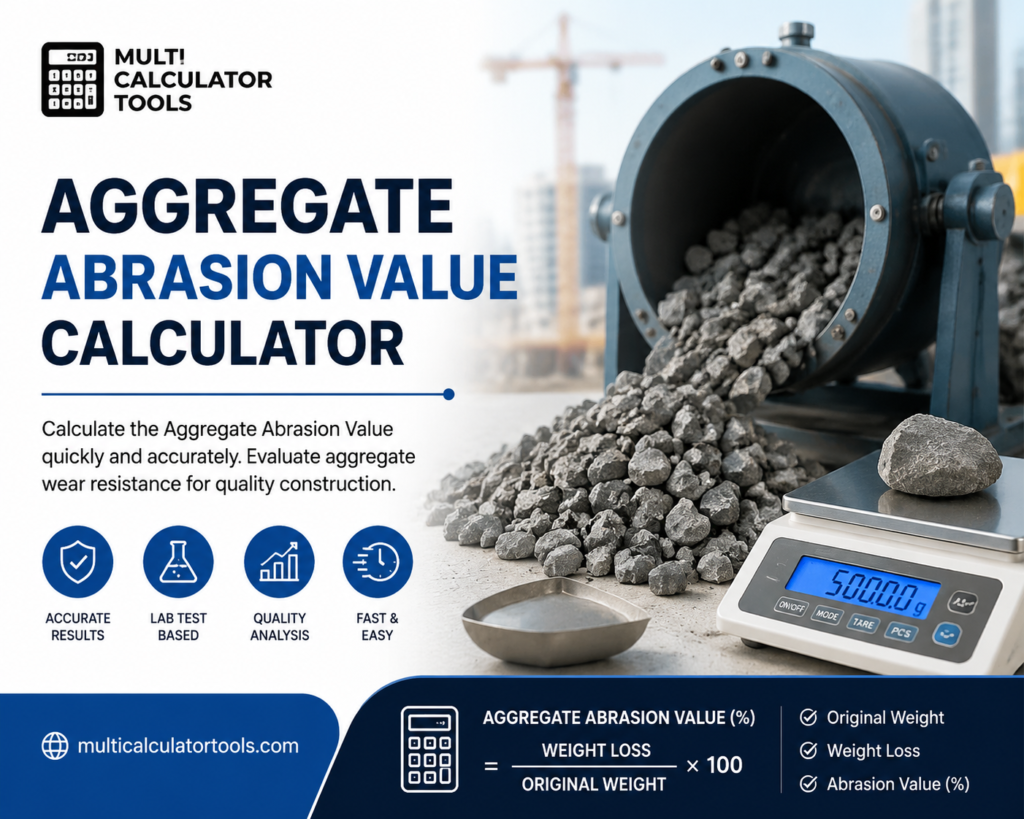
Aggregate Abrasion Value (%) = (Weight Loss ÷ Original Weight) × 100
- Final Weight — the weight of the sample retained after testing (typically after sieving out fine particles produced by abrasion)
- Weight Loss — Original Weight minus Final Weight
- Percentage Loss — the Aggregate Abrasion Value expressed as a percentage
Weight Loss = 5,000 − 4,300 = 700 g Aggregate Abrasion Value = (700 ÷ 5,000) × 100 = 14%
How Does the Aggregate Abrasion Value Calculator Work?
The calculator uses your final weights to figure out the abrasion value.It does this by applying a formula.This gives you a percentage result away. It makes doing calculations by hand unnecessary.
Input fields:
- Original aggregate weight — entered in grams or kilograms
- Final aggregate weight — entered after testing, or you can input weight loss directly
Calculation process:When you put in your numbers the calculator does a things with the weight The calculator is working with the weight to figure this out.
Result interpretation: The output is your Aggregate Abrasion Value as a percentage.
How to Use the Aggregate Abrasion Value Calculator
- Enter the original weight of your aggregate sample.
- Enter the final weight after testing, or enter the weight loss directly.
- Select the measurement unit (grams or kilograms).
- Click Calculate.
- View the Aggregate Abrasion Value as a percentage.
- Compare your result with relevant engineering standards for your project type.
Factors That Affect Aggregate Abrasion Value
. Understanding these factors helps explain variation between test results.
| Factor | Effect | Example |
| Rock type | Harder rock types generally show lower abrasion values | Granite typically outperforms softer limestone |
| Mineral composition | Mineral hardness affects resistance to wear | Quartz-rich aggregates tend to be more durable |
| Aggregate size | Particle size distribution affects test consistency | Standardized grading ensures comparable results |
| Particle shape | Angular particles may behave differently than rounded ones under abrasive load | Crushed stone vs. naturally rounded gravel |
| Moisture | Sample moisture content can affect weight measurements | Wet samples should be dried before weighing |
| Weathering | Weathered or weakened rock shows higher weight loss | Aggregates exposed to freeze-thaw cycles may degrade faster |
| Testing method | Different standardized methods can produce varying results | Los Angeles Abrasion Test vs. other regional test methods |
| Aggregate quality | Poor-quality or contaminated samples skew results | Presence of clay or organic material affects durability |
| Sample preparation | Inconsistent preparation introduces measurement error | Improper sieving before or after testing |
Benefits of Using an Aggregate Abrasion Value Calculator
An Aggregate Abrasion Value Calculator delivers fast, accurate results, saving engineers and lab technicians time on manual calculations. It’s a practical tool for quality assurance, construction planning, and civil engineering education.
- High accuracy — eliminates arithmetic errors in weight-loss calculations
- Time saving — speeds up lab reporting and data processing
- Quality assurance — supports consistent, standardized quality checks
- Laboratory use — assists technicians recording and calculating test data
- Educational use — helps engineering students understand and practice the calculation
Limitations of Aggregate Abrasion Value Calculators. It cannot replace an actual abrasion test or account for testing conditions.
Key limitations include:
- Laboratory data dependency — the calculator is only as accurate as the weight data you provide
- Measurement errors — inaccurate scale readings or improper drying can skew results
- Material variability — natural variation within aggregate sources can affect consistency
- Testing standard differences — different national or regional standards may specify different procedures
- Cannot replace laboratory testing — this tool calculates results from existing data; it doesn’t perform the physical test
- Need for professional engineering judgment — final material approval should involve a qualified engineer, not the calculator alone
This tool does not provide engineering certification or legal advice.
Practical Examples
Railway ballast Original Weight: 5,000 g | Final Weight: 4,600 g | Weight Loss: 400 g Calculated Abrasion Value: 8% Interpretation: Low abrasion value suggesting strong wear resistance, suitable for the heavy repeated loading railway ballast experiences.
Building foundation aggregate Original Weight: 5,000 g | Final Weight: 4,300 g | Weight Loss: 700 g Calculated Abrasion Value: 14% Interpretation: Moderate abrasion resistance; suitability should be checked against the specific structural requirements and local building codes for the project.
If you’d like to cross-check your results or explore how abrasion value calculations are applied across different material testing scenarios, the Aggregate Abrasion Value calculator on Civil Engineering Calculators offers another reference point for running the same formula. Comparing outputs between tools can be a useful way to confirm your calculation before finalizing a lab report or moving forward with material selection for a project.
Tips to Improve Aggregate Quality
To get quality overall we need to find rock that is harder and make sure we test everything the same way when we are picking out materials and checking quality.
- Follow recognized testing standards consistently
- Perform regular abrasion testing across material batches
- Maintain strict quality control procedures at the source and job site
- Purchase certified materials from verified suppliers
- Store aggregates properly to prevent contamination or degradation
- Implement clear quality assurance procedures across your project team
Frequently Asked Questions
What is Aggregate Abrasion Value?
This Aggregate Abrasion Value tells us how well the material can stand up to being worn away by machines and things, like that.
What is the Los Angeles Abrasion Test?
The Los Angeles Abrasion Test is something that a lot of people use in labs. It is a way to see how much the aggregate breaks down. The Los Angeles Abrasion Test does this by rolling a sample, with steel balls in a big drum that spins. The Los Angeles Abrasion Test is used over the world and it is one of the most popular ways to test for abrasion.
Can this calculator replace laboratory testing?
The calculator only uses the weight information you give it from a test. It cannot do the testing by itself. The calculator only works with the weight data you provide from a test.
Is this calculator accurate?
The calculator is only as good, as the information you give it.
Who should use this calculator?
Civil engineers can use this calculator to process abrasion test data.
Conclusion
We need to know how well the materials we use can resist wear and tear. This helps the people in charge of building these things choose the materials and make sure they are good quality. The Aggregate Abrasion Value Calculator on multicalculatortools.com makes it easy to figure out the Aggregate Abrasion Value. It takes the numbers from the lab. Gives us a clear answer in just a few seconds. You can use the Aggregate Abrasion Value Calculator to calculate your Aggregate Abrasion Value now.These calculators can really help with the project you are working on. The Aggregate Abrasion Value is a part of making sure the materials we use are good enough, for the job.