Time Zone Calculator
Convert time between UTC offsets • Time difference
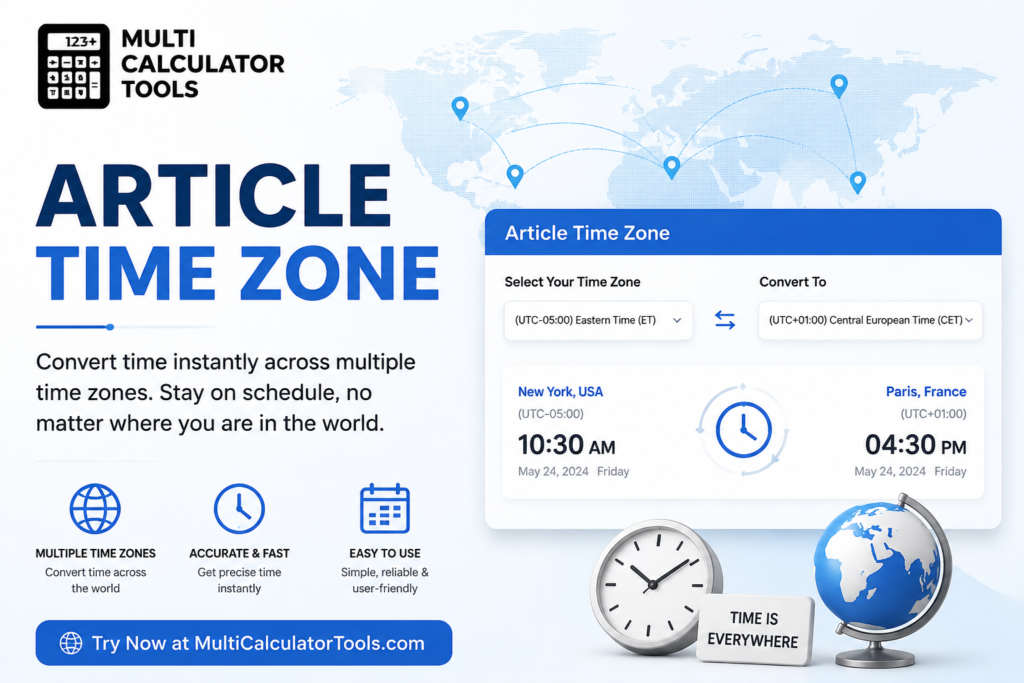
A Time Zone Calculator is really helpful because it converts a time from one time zone to another time zone. It takes care of things like UTC offsets. Daylight Saving Time so you do not have to do the math yourself.Lots of people rely on Time Zone Calculators, like workers, international travelers, event organizers and global teams. Have scheduling problems. This page is here to explain how time zone conversion works what things affect it and how to use the Time Zone Calculator correctly. To get the time conversion you need just enter your source time zone and your destination time zone below. You will get an instant and accurate conversion.
Quick Answer Box
A Time Zone Calculator is really helpful because it can change a date and time from one time zone to another. It does this by considering the difference in time between the two zones and also taking into account the time change that happens during Daylight Saving Time.This is very useful when you need to know what the time is else in the world. For example when you are planning to meet someone in a country or when you are traveling to a new place.A Time Zone Calculator can make sure you have the time for these things, which is important for getting together with people, traveling and working with teams, from other countries.
What Is a Time Zone Calculator?
A Time Zone Calculator helps you figure out the time in another place by adding or subtracting the amount of hours and minutes from the main global time standard called UTC. This tool also considers Daylight Saving Time if its being used in that place.
It makes it easy to know the time in another part of the world
Time zones are measured relative to UTC. Each zone has an offset in hours and sometimes minutes from UTC.
GMT is similar to UTC. Often used in the same way but they are not exactly the same thing.
Many countries change their clocks during times of the year which affects the time difference.
This is important for things like talking to people in countries planning business meetings and traveling.
If you get the time wrong you might miss a flight or a meeting.
One limitation of the Time Zone Calculator is that it uses the time zone rules.
It won’t know about last-minute changes, to time zones made by governments until those changes are updated in its information.
How Does the Time Zone Calculator Work?
The calculator takes your source time zone, the date and time you enter, and your destination time zone, then applies the correct UTC offset for each — including any Daylight Saving Time adjustment — to calculate the equivalent local time.
Key inputs and how they affect the result:
- Source time zone — the location and time you’re converting from.
- Destination time zone — the location and time you want to convert to.
- Date selection — matters because DST rules apply only during specific date ranges, which can shift the offset by an hour depending on the time of year.
- Current UTC offset — each time zone’s fixed distance from UTC, used as the baseline for conversion.
- Daylight Saving Time adjustment — automatically applied if either time zone observes DST on the selected date.
- Time difference calculation — the calculator computes the total hour (and sometimes half-hour or 45-minute) difference between the two zones.
- Output interpretation — you receive the converted local time along with the calculated time difference and UTC offsets for both zones.
How to Use the Time Zone Calculator
- Select the source time zone.
- Enter the date and time.
- Choose the destination time zone.
- Click Calculate.
- View the converted time.
- Check the time difference and UTC offset shown in the result.
Factors That Affect Time Zone Conversion
Time zone conversion depends on more than just a fixed number of hours — factors like Daylight Saving Time, the specific date, and regional exceptions can all change the result.
| Factor | Impact | Example |
| UTC offset | Determines the baseline hour difference between zones | New York is UTC-5 (standard time) |
| Daylight Saving Time | Shifts the offset by one hour during part of the year | New York moves to UTC-4 during DST |
| Country | Some countries span multiple time zones | The United States has six time zones |
| Region | Regions within a country may follow different rules | Some regions don’t observe DST at all |
| Date | DST start and end dates affect whether the shift applies | Early March vs. late November in the US |
| International Date Line | Crossing it changes the calendar date, not just the time | Traveling from Samoa to American Samoa crosses a full day |
| Seasonal time changes | Northern and Southern Hemisphere DST periods run opposite each other | Australia’s DST season differs from the UK’s |
| Local time rules | Some countries have changed or abolished DST in recent years | Time zone policy can vary and change over time |
Benefits of Using a Time Zone Calculator
A Time Zone Calculator is really helpful because it gives you the time in different places right away. This helps you plan things like meetings, trips and events without making mistakes when you are trying to figure out the time. The Time Zone Calculator is especially useful, for people who have to work with others in different areas all the time.
- Accurate time conversion — removes manual math and reduces mistakes
- Better meeting planning — helps you find suitable times for international calls
- Easier international communication — keeps global teams aligned on scheduling
- Improved travel scheduling — helps you plan arrivals, departures, and layovers correctly
- Remote work coordination — supports teams working across different regions
- Event planning — ensures international attendees receive correct local start times
- Reduced scheduling errors — minimizes the risk of missed meetings or double-booked calls
- Time-saving calculations — delivers instant results instead of manual lookup
Limitations of Time Zone Calculators
Time Zone Calculators are generally reliable, but they may not immediately reflect very recent or unusual local time policy changes. It’s worth verifying critical schedules with an official local source when precision really matters.
Specific limitations include:
- Sudden government time zone changes — some countries adjust time zones or DST policy with little notice
- Local legislative updates — data may lag briefly behind newly passed time zone laws
- Historical time zone changes — past date conversions can be affected by since-changed rules
- Rare regional exceptions — a handful of regions follow non-standard offsets (like 30 or 45-minute increments)
- Device time settings — incorrect device clock settings can cause confusion separate from the calculator itself
For high-stakes scheduling — international flights, legal deadlines, or official appointments — confirm the exact local time through an official source as well.
Practical Time Zone Conversion Examples
New York to LondonNew York is in Eastern Time, which’s UTC-5 when it is standard time and UTC-4 when it is daylight saving time. London is UTC+0 when it is time and UTC+1 when it is British Summer Time.The time difference between New York and London is usually 5 hours when both cities are following time. New York and London still have a 5 hour time difference when both cities are following daylight saving time because New York and London change their clocks at the time.
Los Angeles to Tokyo Los Angeles (Pacific Time, UTC-8 standard / UTC-7 during DST) to Tokyo (UTC+9, no DST observed). The difference is typically 17 hours during Pacific Standard Time, or 16 hours during Pacific Daylight Time, since Tokyo doesn’t shift its clocks.
Sydney to Dubai Sydney (UTC+10 standard / UTC+11 during Australian DST) to Dubai (UTC+4, no DST observed). The difference is typically 6 hours during Australian standard time, or 7 hours during Australian daylight saving time.
India (IST) to UTC India Standard Time is a fixed UTC+5:30 offset with no Daylight Saving Time observed. Converting IST to UTC always means subtracting 5 hours and 30 minutes, regardless of the time of year.
Toronto to Paris Toronto (Eastern Time, same offsets as New York) to Paris (UTC+1 standard / UTC+2 during CEST). The typical difference is 6 hours, since both regions generally shift their clocks around similar times of year, though brief transition-week differences can occur.
Tips for Managing Multiple Time Zones
Managing schedules across time zones is easier when you use UTC as a shared reference point and stay aware of Daylight Saving Time changes throughout the year.
- Use UTC as a neutral reference point when coordinating with multiple regions
- Schedule meetings during overlapping business hours whenever possible
- Check whether Daylight Saving Time affects either party before finalizing a time
- Use a world clock to quickly check multiple time zones at once
- Confirm meeting invitations show the correct time zone for every participant
- Avoid scheduling near midnight, since it increases the risk of date confusion
- Plan international travel with time zone changes factored into your itinerary
Frequently Asked Questions
What is a Time Zone Calculator?
A Time Zone Calculator is a tool that converts a specific time from one location to the equivalent local time in another, accounting for UTC offset and Daylight Saving Time. It helps avoid manual calculation errors when scheduling across regions.
How do I calculate the time difference between two countries?
You find each country’s UTC offset, then calculate the difference between them, adjusting for Daylight Saving Time if either observes it on the relevant date. A Time Zone Calculator automates this process instantly.
What is UTC?
UTC, or Coordinated Universal Time, is the global time standard used as a reference point for all time zones. Every time zone is defined by its offset from UTC, such as UTC+5:30 or UTC-8.
What is GMT?
GMT, or Greenwich Mean Time, is the time at the Prime Meridian and is closely related to UTC. In practice, GMT and UTC are often used interchangeably, though UTC is the more precise modern standard.
How does Daylight Saving Time affect time conversion?
Daylight Saving Time shifts a region’s clocks forward or back by one hour during part of the year, changing its effective UTC offset temporarily. This can alter the time difference between two zones depending on the date.
Why do some countries have different time zones? Time zones are based on longitude and the sun’s position, but political and economic factors also influence how countries draw their zone boundaries. Some large countries span multiple time zones for this reason.
How accurate is a Time Zone Calculator?
A Time Zone Calculator is highly accurate for standard time zone conversions, including Daylight Saving Time adjustments. Accuracy can occasionally lag behind very recent, unannounced local time policy changes.
Can I convert future dates?
Yes, most Time Zone Calculators support future date conversions, applying known Daylight Saving Time rules for that date. This is useful for planning events or meetings scheduled months in advance.
Does this calculator account for DST?
Yes, the calculator automatically applies Daylight Saving Time adjustments based on the date and time zones you select, as long as the region currently observes DST under standard rules.
Beyond calculating a single time conversion, it’s often useful to see a live overview of what time it is right now across multiple regions at once. Sites like timeanddate.com offer real-time world clocks and time zone lookups that pair well with a calculator when you’re coordinating something time-sensitive, like an international call or a multi-city event. Using both together — a calculator for precise conversions and a live world clock for quick reference — helps reduce the chance of scheduling errors across time zones.
Conclusion
Accurate time conversion is essential for scheduling international meetings, planning travel, and coordinating global teams without confusion. A Time Zone Calculator takes the guesswork out of figuring out UTC offsets and Daylight Saving Time, giving you a reliable result in seconds. Use the Time Zone Calculator on multicalculatortools.com to convert time between any two locations, and explore our other productivity tools to keep your schedule accurate and stress-free.