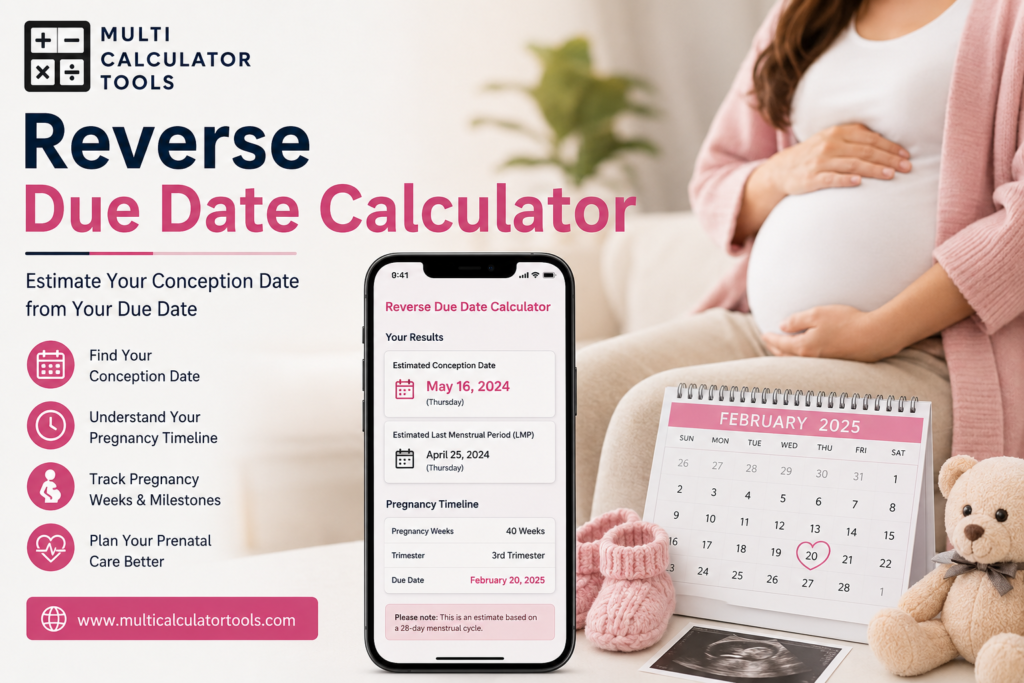
Introduction
A Reverse Due Date Calculator is a tool that can be used to calculate the likely date of conception, when you are working backwards from your due date. For those who are expecting, wondering about the stages of pregnancy, for those who are confirming fertility windows, for students who are learning about obstetrics dating, and for anyone that is reconstructing a pregnancy calendar. This tool calculates your probable conception date, your estimated last period (LMP), and other pregnancy milestones, from one due date. Fill in your due date below and you’ll receive instant and easy-to-understand results.
Quick Answer
A Reverse Due Date Calculator estimates your conception date by counting backward from your due date, typically subtracting 266–280 days depending on the dating method used. It also estimates your last menstrual period (LMP) and pregnancy timeline, giving a helpful — though approximate — picture of when conception likely occurred.
What Is a Reverse Due Date Calculator?
The Reverse Due Date Calculator is an online tool to estimate the likely due date and last menstrual period (LMP) based on a known or estimated due date. This goes against the usual method of determining the due date—from LMP to due date—to work out the due date from the time of conception to the due date.Because the exact date of conception is often not known, the pregnancy dating system is based on a 280-day (40-week) gestation period from the first day of the LMP. This convention, with ultrasound measurements, is what healthcare providers use to estimate the Estimated Delivery Date (EDD).
How Does the Reverse Due Date Calculator Work?
- The calculator is reverse logic, working on the basis of obstetric timing rules, and using the due date to guess the timing of conception and LMP and also the timing of ovulation. Usually calculates a 40 week (280 day) gestation period and a 14 day luteal period, and then retreats to calculate an estimated pregnancy period.
- Each input and output represents what:
- Due date: The approximate date of birth (due date) or manually entered due date.
- Pregnancy length: Full-term pregnancy is 280 days (40 weeks) from LMP (can be adjusted for early or late pregnancy estimates depending on calculator).
- Gestational age: Time of pregnancy using LMP as the clinical reference point.
- Last menstrual period (LMP): Date is arrived at by subtracting 280 days from the due date.
- Estimated conception date: This is the date a person thinks she became pregnant, usually 266 days prior to last menstrual period (LMP) because of the average time from LMP to ovulation.
- Ovulation timing: This is assumed to be about day 14 of a 28 day cycle, but day of ovulation varies for longer or shorter cycles.
- Output interpretation: The calculator displays a range of days – not a definite day – on which the woman may conceive, as well as the associated LMP date and the current gestational week.
Factors That Affect Reverse Due Date Estimates
Several variables influence how accurate a reverse due date estimate can be. The table below summarizes the most common factors and their typical impact.
| Factor | Impact on Estimate | Example |
| Due Date Accuracy | A due date based on an early ultrasound is more reliable than one based on guesswork | Ultrasound-confirmed due dates narrow the conception window |
| Last Menstrual Period (LMP) | Uncertain or forgotten LMP dates reduce estimate precision | Irregular period tracking widens the estimated range |
| Ovulation Timing | Early or late ovulation shifts the true conception date | Ovulation on day 10 instead of day 14 moves conception earlier |
| Menstrual Cycle Length | Cycles shorter or longer than 28 days change the conception window | A 35-day cycle typically means later ovulation |
| Ultrasound Dating | First-trimester ultrasounds are considered the most accurate dating method | Ultrasound may adjust a due date by several days |
| Fertility Treatments (IVF) | IVF pregnancies have a known, exact conception or transfer date | IVF removes most guesswork from conception dating |
| Multiple Pregnancy | Twin or multiple pregnancies are sometimes dated slightly differently | Due dates may be adjusted for multiples |
| Irregular Cycles | Irregular ovulation makes LMP-based estimates less reliable | Conception window may span a week or more |
| Gestational Age | Errors in gestational age tracking shift all downstream estimates | A one-week miscalculation shifts conception by a week |
Benefits of Using a Reverse Due Date Calculator
- Estimating conception date: Useful if time of pregnancy is significant or if a person just wants to know.
- Knowing the time line of a pregnancy: Giving a clear picture of how the pregnancy is going.
- Fetal Development:Tracks fetal development according to the normal stages of fetal growth.
- Proper prenatal planning: Helps to arrange the necessary appointments, screening and tests at the right time in the pregnancy.
- Pregnancy education: Provides an easy means to learn about the obstetric dating norms.
- Improved communication with healthcare providers: Provides a place to start talking with the provider about dating discrepancies or concerns with a provider.
Limitations of Reverse Due Date Calculators
Reverse due date calculators are helpful but don’t consider all the factors that can influence the timing of pregnancy. Limitations include:
Irregular menstrual cycles – makes LMP calculation less accurate.
Early or late ovulation, thus affecting the real time of conception.Early dating scans may cause the due date to be shifted with ultrasound adjustments.
IVF pregnancies, where conceptions date are not assumed and different than the natural cycle.
Pregnancy complications which can have an effect on normal dating routines.
Differences in the growth and development of the fetus.
Medications that may impact the length of the cycle or the date used for pregnancy dating
Tips for Accurate Pregnancy Dating
- Try to keep a regular menstrual cycle and use an app or a calendar to help determine a reliable LMP.
- Keep track of the dates of ovulation by taking BBT or using an OPK.
- Get a prenatal check-up early in pregnancy.
- Have an ultrasound done in the first trimester, this is the most accurate dating that you can get.
- Maintain pregnancy records, such as dates of pregnancy tests and provider comments, to keep handy.
- Accept health care provider suggestions for due date changes.
- Pregnancy calculators are an estimation tool and may not be a medical date.
Frequently Asked Questions
What is a Reverse Due Date Calculator? A Reverse Due Date Calculator is a tool that figures out when you got pregnant and when you had your period. It does this by going from the date your baby is due. This is the opposite of how doctors do it. They normally start with the date of your period and work forward.
How accurate is a Reverse Due Date Calculator?The accuracy of this thing really depends on how regular your cycle’s how you figured out your due date. If you got an ultrasound to confirm your date that is a pretty good way to get a reliable estimate.. If your cycle is all over the place or you are not really sure when your last period was, that makes it harder to know when you got pregnant.
______________________________________________________________________________________________________
Can I estimate my conception date from my due date?To figure out when you got pregnant you can try subtracting around 266 days from when your baby’s due. This works because most women have a 28 day cycle and they usually ovulate at a time. So if you do the math you can get an idea of when you got pregnant. The thing is, this is not a science so the real conception date could be a few days before or, after that estimate.
Does the calculator work for irregular periods? The thing is, it can still give us an idea of when the baby was made even if the woman has periods.. We have to remember that this will not be totally accurate. When a womans body does not follow a schedule it is harder to figure out when she got pregnant. This means the real date that the baby was made could be within a big time frame.
Is conception the same as fertilization? Conception and fertilization are the thing. They happen when a sperm meets an egg. This usually occurs within 24 hours of ovulation. Sperm can live in the tract for a few days, before ovulation. That’s why the timing estimates can vary a bit.
Conclusion
Knowing the due date workflow, LMP and due dates are linked is the first step in pregnancy timeline. A Reverse Due Date Calculator can help you determine the approximate due date based on the month you conceived, facilitating the understanding of your pregnancy stage and planning the prenatal care. These are estimates and not a replacement for medical dating techniques, such as ultrasound. Use the Reverse Due Date Calculator today to find out when you are likely to have conceived and visit our other pregnancy tools to find out more about your pregnancy journey.