Introduction
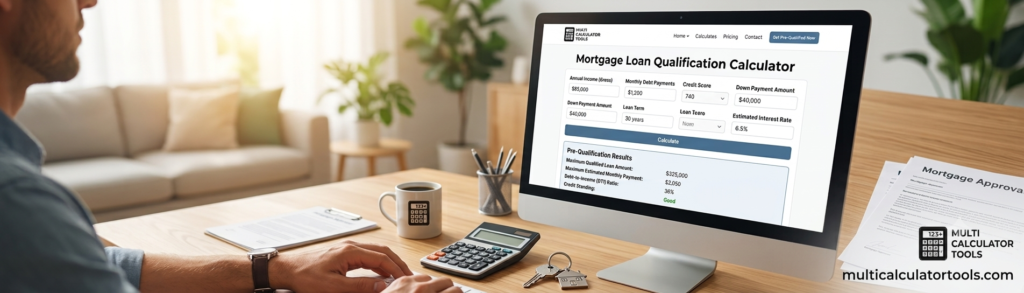
Before you choose a house it’s good to know what a lender will actually say yes to. A mortgage loan qualification calculator uses your income, debts, credit score and down payment to give you an idea of what you can borrow.It matters because lenders don’t just look at how much you want to spend on a house.They look at how risk you are and thats a different number.This tool is for people who are buying a house for the time and don’t know where to begin.It is also, for couples who are combining their incomes investors who are looking at a property and anyone who wants to know now instead of being surprised later.You will see what goes into the estimate and how to understand the resultsYou can try the calculator as you go along.
Quick Answer
A mortgage loan qualification calculator helps you figure out how money you can probably borrow. This is based on a things: your income, the debts you have to pay every month your credit score and the down payment you can make. The calculator uses the rules that lenders use to decide how much money they will lend you. Usually lenders think that you should not spend than twenty eight percent of the money you make on housing costs. They also think that your total debt should not be, than thirty six to forty three percent of the money you make. This gives you an idea of how much money you can borrow before you even apply for a mortgage loan.
What Is a Mortgage Loan Qualification Calculator?
It’s a tool that estimates how much mortgage you can likely qualify for by running your financial profile through the same debt-to-income math lenders use during underwriting. Instead of guessing, you get a number grounded in actual lending guidelines.Lenders check if you can afford to repay a mortgage. They want to make sure you have money to pay back the loan without struggling. One way they do this is by looking at your debt-to-income ratio or DTI.The DTI compares how much you owe each month to how much you earn.This is a factor, in their decision.Your credit score is also important.It shows lenders if you have paid your debts on time in the past.Lenders use your credit score to see if you are reliable
How Does the Mortgage Loan Qualification Calculator Work?
The calculator combines your income, debt, credit, and loan details to estimate both your DTI ratio and a realistic loan amount. Each input plays a specific role in that estimate, and understanding what each one does makes the output far more useful.
Here’s what goes into it:
- Annual income — your gross yearly earnings before taxes; the calculator converts this to a monthly figure.
- Monthly income — used directly if you’d rather skip the annual conversion.
- Down payment — reduces your loan amount and can affect whether PMI applies.
- Loan amount — the estimated amount you’d need to borrow based on home price minus down payment.
- Property taxes — factored into your total housing expense ratio.
- Homeowners insurance — also rolled into your estimated monthly housing cost.
- PMI — added if your down payment is under 20% on a conventional loan.
How to Use the Mortgage Loan Qualification Calculator
- Enter your annual income.
- Add your monthly debt payments.
- Enter your credit score.
- Provide your down payment amount.
- Enter the estimated home price you’re considering.
- Select the mortgage interest rate.
- Choose the loan term.
- Include estimated property taxes and insurance.
- Click Calculate.
- Review your estimated mortgage qualification results.
Factors That Affect Mortgage Loan Qualification
| Factor | Impact on Qualification | Example |
| Income | Higher income supports a larger loan amount | $95,000/year qualifies for more than $55,000/year, all else equal |
| Employment History | Steady, verifiable employment reassures underwriters | Two years in the same field strengthens an application |
| Monthly Debt | More existing debt lowers how much you can borrow | $800/month in car and card payments reduces qualifying loan size |
| Debt-to-Income Ratio | Lower DTI generally means easier approval and better terms | A 32% DTI is viewed more favorably than a 48% DTI |
| Credit Score | Higher scores unlock better rates and more loan options | A 760 score often beats a 620 score by half a point or more on rate |
| Down Payment | Larger down payments reduce loan size and may remove PMI | 20% down avoids PMI on most conventional loans |
| Loan Amount | Bigger loans mean higher monthly payments and stricter scrutiny | A $450,000 loan requires more income to qualify than a $250,000 loan |
| Interest Rate | Higher rates raise the monthly payment and lower buying power | A 1-point rate increase can cut qualifying loan size noticeably |
| Property Taxes | Higher local taxes raise total housing cost | Higher-tax counties reduce how much home you can qualify for |
| Homeowners Insurance | Adds to monthly housing expense ratio | Coastal or high-risk areas often carry higher premiums |
| PMI | Adds monthly cost when down payment is under 20% | PMI can add $100–$300/month on a typical loan |
| Loan Type | Different programs have different qualification thresholds | FHA loans often allow higher DTI than conventional loans |
Benefits of Using a Mortgage Loan Qualification Calculator
Running your numbers ahead of time saves you from wasting effort on homes you were never going to qualify for. It shows roughly what a lender will see, so there’s no guessing about your DTI ratio or whether your credit score puts you in a stronger or weaker position. It’s useful for comparing scenarios too — what happens if you save a bigger down payment, or pay off a car loan first? You can test both without touching your credit report. And honestly, walking into a lender’s office (or their website) already knowing your rough numbers just makes the whole process feel less intimidating.
Limitations of Mortgage Loan Qualification Calculators
A calculator estimates. It doesn’t decide. Real underwriting involves things a calculator simply can’t see: a lender’s specific internal policies, verification of your actual employment and income documents, a look at your assets and reserves, and a fresh pull of your credit report that might turn up something you forgot about. It also can’t predict your closing costs, how an appraisal will come in, whether rates shift between now and closing, or local lending rules that vary by state or loan program.
So treat your results as a starting point for the conversation, not the final word. Before making an offer on a home, get an actual pre-approval from a qualified mortgage lender — it carries real weight with sellers, and it’ll catch anything this calculator can’t.
Tips to Improve Mortgage Loan Qualification
- Increase your income where you can — a raise, a side income stream, or a second earner on the application all help.
- Pay off the debt you already have. Focus on high-interest debt like credit card balances. This is because paying them down directly improves your debt-, to-income ratio.
- To get a credit score you should pay your bills on time. This is very important.
- Save a larger down payment to shrink your loan amount and potentially skip PMI.
- Avoid taking on new debt before applying — a new car loan right before closing has derailed more than one approval.
Frequently Asked Questions
What is a Mortgage Loan Qualification Calculator?
This is a tool that helps figure out how mortgage you could really get, based on your income the debt you have each month your credit score and the down payment. The mortgage tool uses the rules that lenders use to decide how much debt is okay compared to your income so you get a realistic idea of how much mortgage you could get before you start looking for a house or talking to a bank about a mortgage.
How much mortgage can I qualify for?
This all depends on how money you make and what you already owe. Your credit score is important too. A lot of people think it is an idea to spend around 28 percent of the money you make each month on a house. They also think you should not owe than 36 to 43 percent of your monthly income in total. If you want to know what is right for you you can use the calculator. Enter your own numbers. That way you will get an idea that’s specific, to your situation and the calculator will give you a better estimate of what you can afford.
What credit score do I need for a mortgage?
Conventional loans usually need a credit score of around 620.. You will get better interest rates if your score is around 700 or higher.FHA loans are different. They let people get a loan with a credit score low, as 580. This is if you make a down payment. If you make a down payment your credit score can be even lower. It really depends on the lender. What they will accept for FHA loans.
What’s the difference between prequalification and preapproval?
So when you are looking at Prequalification it is like an simple guess based on the numbers you give yourself kind of like what you get from this calculator. On the hand Preapproval is when a lender checks out your income and assets and credit to see if you are good for the money. This results in a commitment from the lender, which means a lot more when you are trying to make an offer on a house, with Preapproval.
Conclusion
Checking your mortgage eligibility before you apply saves you time, protects you from disappointment, and gives you a real number to shop with instead of a guess. Run a few scenarios through the calculator above — try different down payments, pay off a debt on paper and see what changes, test a couple of credit score ranges. Once you have a solid estimate, take the next step and explore the related calculators below to round out your home-buying plan.