Introduction
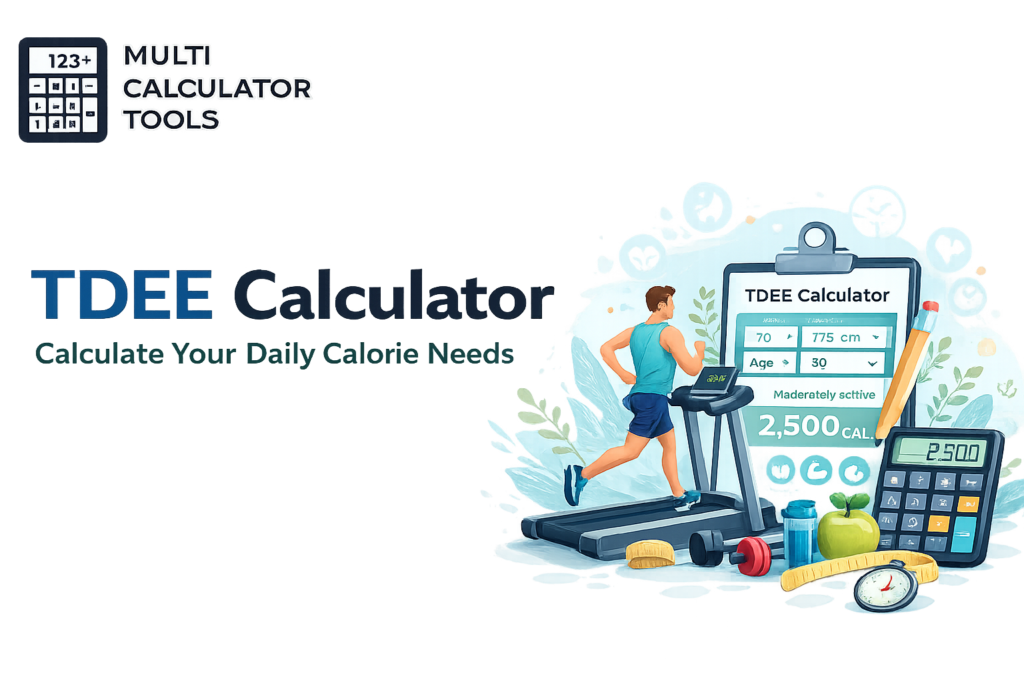
Your Total Daily Energy Expenditure is the number of calories your body burns in a day. This includes everything from bodily functions to workouts and daily movement. Your Total Daily Energy Expenditure is a number to know.The Total Daily Energy Expenditure Calculator estimates your Total Daily Energy Expenditure using your age, sex, height, weight and activity level. This gives you a starting point for any nutrition or fitness plan.If you want to lose fat build muscle or just stay at your weight knowing your Total Daily Energy Expenditure helps. You do not have to guess how calories you should eat. People who are new to fitness athletes and coaches all use the Total Daily Energy Expenditure as the foundation, for setting calorie targets.You can enter your details below to get your Total Daily Energy Expenditure estimate in seconds.
Quick Answer Box
Total Daily Energy Expenditure is what TDEE stands for. This is the number of calories that your body burns each and every day. Your body uses Total Daily Energy Expenditure to keep everything running smoothly. So Total Daily Energy Expenditure is really the calories that your body burns every single day. This includes your BMR, which’s the calories you burn at rest and the calories you burn through daily activities, exercise and digestion. A TDEE calculator helps you figure out this number. This helps you set calorie goals for losing weight maintaining weight or gaining muscle.
What Is a TDEE Calculator?
A TDEE Calculator estimates how many calories you burn in a day based on your age, sex, height, weight, and activity level. It starts with your Basal Metabolic Rate (BMR)—the calories your body needs at rest—and adds calories burned through daily activities, exercise, and digestion. Knowing your Total Daily Energy Expenditure (TDEE) helps you plan your calorie intake for weight loss, maintenance, or muscle gain. Your estimate is influenced by age, sex, body size, and activity level, but actual calorie needs may vary from person to person.
How to Use the TDEE Calculator
1. Please tell us how old you are.
2. What is your biological sex?
3. How tall are you?
4. What is your current weight?
5. How would you describe your daily activity level?
6. Now click the Calculate button.
7. Take a look at your estimated BMR and TDEE results.
8. Use these results to figure out your calorie needs, for maintenance, weight loss or weight gain.
Factors That Affect Total Daily Energy Expenditure
TDEE isn’t a fixed number — it shifts based on several personal and lifestyle factors.
| Factor | Impact on TDEE | Example |
| Age | TDEE generally decreases gradually with age | A 25-year-old typically has a higher TDEE than a 55-year-old at the same weight |
| Biological Sex | Affects average muscle mass and hormone levels | Men often have a higher average BMR than women at similar stats |
| Weight | Higher body weight generally increases TDEE | 200 lb person vs 140 lb person at the same activity level |
| Height | Taller individuals often have a higher BMR | 6’2″ vs 5’4″ at the same weight and age |
| Activity Level | The single largest driver of TDEE variation | Sedentary vs extra active can shift TDEE by 500–1,000+ calories |
| Muscle Mass | More lean muscle increases resting calorie burn | Muscle burns more calories at rest than fat tissue |
| Body Composition | Lower body fat percentage often correlates with higher TDEE | Athlete vs non-athlete at the same total weight |
| Exercise Frequency | More frequent training increases total daily burn | Training 5x/week vs 1x/week |
| Occupation | Physically demanding jobs raise daily energy use | Construction worker vs desk-based office worker |
| Health Conditions | Certain conditions can raise or lower metabolic rate | Thyroid-related conditions can affect BMR |
Benefits of Using a TDEE Calculator
You get a calorie plan that is made just for you, based on your own information not just a random guess.
• Managing your weight is about setting calorie goals that are right for you not just eating less food without a plan.• It is a lot easier to plan your meals when you have an idea of how many calories you should eat every day. • When you want to get fit it is really helpful to keep track of how you’re doing and make changes to what you eat based on your weight and how active you are, with managing your weight and getting fit. • If you want to build muscle you need to figure out how extra calories you need to eat to support that. • Losing fat is easier when you have a plan that helps you cut back on calories in a way that’s sustainable.
Limitations of TDEE Calculators
Total Daily Energy Expenditure calculators give you a good idea, but not an exact number because peoples bodies are all different and no formula can cover all of that. Knowing this helps you use the number as a guide instead of a hard and fast rule.
These tools usually cannot take into account everything, such as:
Inividual metabolic differences
Hormonal changes
Underlying conditions
Pregnancy
Illness or recovery periods
How your body gets used to dieting or overeating for a time
Differences in body composition that you cannot tell by looking at your weight and height
Mistakes people make when they report how active they are If you need personalized advice, on what to eat especially if you have a medical condition are pregnant or are trying to lose a lot of weight you should talk to a doctor or a registered dietitian who can help you with Total Daily Energy Expenditure and other things.
If you’re unsure how many calories you should consume each day, a TDEE Calculator provides a quick estimate based on your personal details and activity level. It is a useful resource for planning balanced nutrition, managing weight, and setting realistic fitness goals.
Practical TDEE Examples
Practical TDEE Examples
Here are a few examples of how a TDEE Calculator can estimate daily calorie needs:
Older Adult: A lightly active 60-year-old woman (5’4″, 150 lbs) has a BMR of about 1,250 calories and a TDEE of approximately 1,700 calories/day, reflecting the natural decline in metabolism with age.
Office Worker: A 35-year-old man (5’10”, 180 lbs) with a sedentary lifestyle has a BMR of about 1,750 calories and a TDEE of around 2,100 calories/day.
Moderately Active Adult: A 28-year-old woman (5’5″, 140 lbs) who exercises 3–4 times a week has a BMR of about 1,400 calories and a TDEE of approximately 2,150 calories/day.
Athlete: A 24-year-old man (6’0″, 190 lbs) who trains intensely has a BMR of about 1,900 calories and a TDEE of around 3,100 calories/day.
Weight Loss Goal: If your TDEE is 2,150 calories, consuming 1,650–1,850 calories per day can create a calorie deficit for gradual, sustainable weight loss.
Muscle Gain Goal: If your TDEE is 2,800 calories, eating 3,050–3,300 calories daily can support muscle growth when combined with strength training.
Tips to Improve Your TDEE and Reach Your Goals
Stay active: Regular exercise increases your daily calorie burn and supports overall health.
Build muscle: More muscle helps your body burn more calories, even at rest.
Eat a balanced diet: Include enough protein to maintain muscle and support recovery.
Stay hydrated: Drinking enough water helps your body function efficiently and supports energy levels.
Get enough sleep: Quality sleep helps regulate hunger hormones, metabolism, and energy.
Track your calories: Monitoring your food intake makes it easier to stay on target and adjust your goals.
Make gradual changes: Increase or decrease calories slowly while maintaining a consistent exercise routine for sustainable results.
Frequently Asked Questions
What is TDEE?
The Total Daily Energy Expenditure or TDEE for short is really the total number of calories that your body burns in a day. This Total Daily Energy Expenditure includes a things. It includes your Basal Metabolic Rate, which is the number of calories your body burns when you are not doing anything plus the calories that you burn when you are doing things, like daily activity, exercise and even digestion of the food you eat. The Total Daily Energy Expenditure is a thing to know about your body.
What is the difference between BMR and TDEE?
Your body needs a number of calories to function properly when you are not doing anything. This is called BMR. BMR is the number of calories your body needs at rest to maintain basic functions like breathing and circulation.TDEE is related to BMR. TDEE builds on BMR by adding the calories that your body burns when you move around exercise and do your activities, like TDEE and BMR.
How accurate is a TDEE Calculator?
TDEE calculators give us an idea of how many calories we need, using things like the Mifflin-St Jeor formula. The thing is, every persons metabolism is different. So when we talk about TDEE we have to remember that our actual calorie needs can be really different from what the TDEE calculator says.It can be different by a lot of calories like a hundred.This is because of things, like how muscle we have and if we have any health problems.TDEE is an estimate. We have to think about our own personal factors when we are trying to figure out how many calories we really need from the TDEE.
How many calories should I eat to lose weight?
So when people want to lose weight they usually try to eat 300 to 500 calories than their body needs.This helps them create a calorie gap.The gap helps with weight loss that is easy to maintain.People lose weight when their body uses this gap, for energy.They eat less. Their body uses stored energy.This way weight loss happens slowly.. Some people try to eat less but that can be really hard to do for a long time. The goal is to find a balance with the calories and the weight loss like with the Total Daily Energy Expenditure or the TDEE which’s the amount of calories the body needs. Eating less than the Total Daily Energy Expenditure or the TDEE is the key, to losing weight.
How many calories should I eat to gain muscle?
A small extra amount of calories 250 to 500 calories more than what your body needs can help you gain muscle. This is called being, in a calorie surplus. It works well when you eat protein and do weight training. This way you can gain muscle. Not get too much fat.
Does exercise increase TDEE?
Yes. Exercise is really important because it increases the number of calories you burn every day. This is in addition to the calories your body burns when it is at rest which is called your Basal Metabolic Rate or BMR. So the amount of activity you do every day has a big impact, on the total number of calories you burn which is also known as your Total Daily Energy Expenditure or TDEE.
How often should I recalculate my TDEE?
It’s good to recalculate your calories every weeks.. Do it after you have a big change, in weight exercise routine or fitness goals. This is because these things directly affect how calories you need.
Which activity level should I choose?
When you think about your week pick the activity level that sounds most like you. This includes things like going to the gym. Also just moving around every day. A lot of people make the mistake of thinking they are more active than they really are. This can cause problems because it means you might not be getting the amount of calories. Choose the activity level that best reflects your week including both structured exercise, like going to the gym and daily movement like walking around the house.
Can TDEE change over time?
Yes. Your TDEE can change when your weight, muscle mass, age and activity level change. When you diet for a time your metabolism can adapt and change.That is why it is an idea to recalculate your TDEE from time to time.This helps ensure you are using the numbers, for your body.Your TDEE is not set in stone it shifts with your lifestyle.So keep an eye on your weight, muscle and activity level.Recheck your TDEE often to stay on track.
Is a TDEE Calculator suitable for athletes?
So athletes might have to choose an activity level or change the results to fit their training. This is because the usual activity categories do not really show how hard they train. Athletes have to do this because the standard activity categories do not fully capture the high training loads that athletes have.
Conclusion
Figuring out your Total Daily Energy Expenditure is really helpful. It gives you an idea of what you need to know when you are making a plan for food or exercise. You might want to lose weight or get muscles or just stay the same. The Total Daily Energy Expenditure Calculator can tell you what your own number is. Then you can use our tools to learn more about what you need to eat to be healthy. The Total Daily Energy Expenditure is important to know when you are trying to make a plan that’s just right, for you.