Introduction
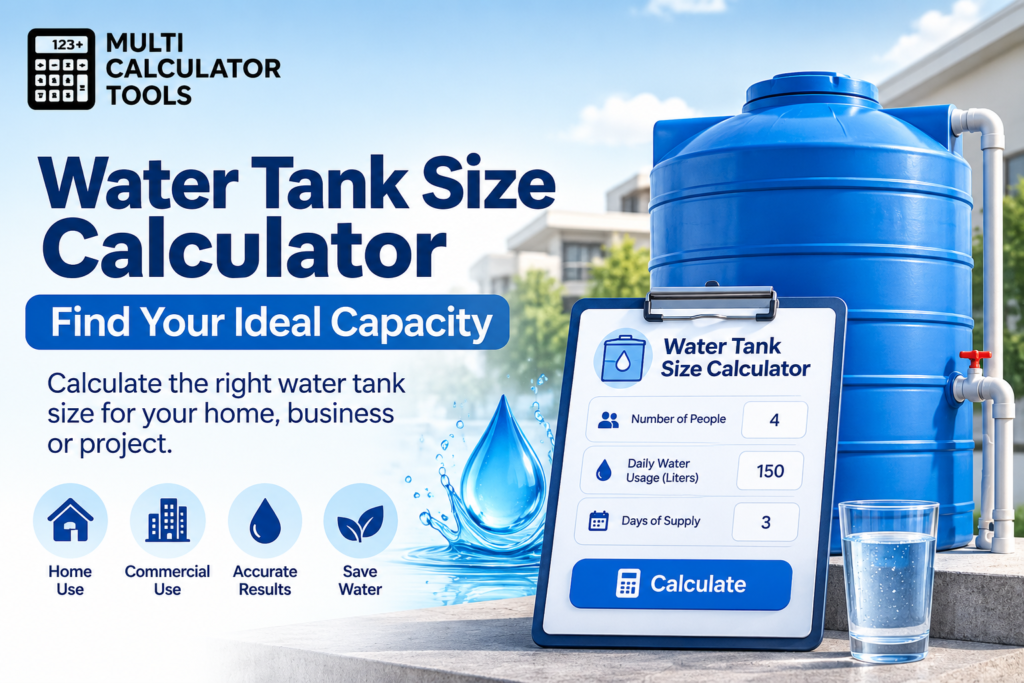
A Water Tank Size Calculator helps you estimate the ideal tank capacity based on your household size, daily water usage, and the number of backup storage days you need. Choosing the right tank prevents water shortages and avoids unnecessary costs. It’s useful for homeowners, builders, architects, farmers, and anyone planning a rainwater harvesting system. With this tool, you can quickly calculate the right tank size, explore practical examples, and make a more informed water storage decision.
Quick Answer
A Water Tank Size Calculator estimates the storage capacity you need based on the number of people using the water, daily consumption per person, and how many days of storage you want. It converts this into a tank volume in liters, gallons, or cubic meters, using either a preset demand figure or your tank’s actual dimensions.
What is Water Tank Size Calculator?
A Water Tank Size Calculator helps you estimate the ideal water tank capacity based on your daily water usage and the number of backup days you need. It calculates the recommended tank size in liters, gallons, cubic meters, or cubic feet. Choosing the right tank size helps ensure a reliable water supply while avoiding unnecessary costs. It is useful for homes, businesses, farms, and rainwater harvesting systems. Although the calculator provides a reliable estimate, your actual water storage needs may vary based on climate, household size, and local water availability. For large or complex projects, consult a professional before making a final decision.
How Does the Water Tank Size Calculator Work?
A Water Tank Size Calculator estimates the right tank capacity by multiplying your daily water usage by the number of storage days or by calculating the volume from your tank’s dimensions. Key inputs include the number of users, daily water consumption, storage days, tank shape, and dimensions (length, width, height, or diameter). It supports units such as liters, gallons, cubic meters, and cubic feet. For volume calculations, rectangular tanks use Length × Width × Height, while round tanks use π × radius² × Height.
How to Use the Water Tank Size Calculator
- Enter the number of occupants or your known daily water demand.
- Select your preferred measurement unit (liters, gallons, cubic meters, or cubic feet).
- Choose the tank shape — cylindrical or rectangular.
- Enter tank dimensions if you’re checking an existing or planned tank.
- Specify the number of storage days you want as a buffer.
- Click Calculate.
- Review the recommended tank capacity.
- Compare different tank sizes before making a purchase.
Factors That Affect Water Tank Size
Several variables influence how large a tank you actually need. The table below breaks down the most common ones.
| Factor | Impact on Tank Size | Example |
| Household Size | More occupants increase total daily demand | A family of 6 needs roughly 50% more capacity than a family of 4 |
| Daily Water Usage | Higher per-person consumption increases total demand | A household with a garden and pool uses more than one without |
| Storage Duration | More reserve days require proportionally more capacity | 7 days of backup needs 7x the capacity of 1 day |
| Tank Shape | Changes the formula used to calculate volume from dimensions | A tall cylindrical tank may hold less than a wide rectangular one of similar footprint |
| Rainwater Harvesting | Local rainfall patterns affect how much capacity is useful | Areas with seasonal rain often need larger tanks to bridge dry months |
| Climate | Hot or dry climates typically increase water demand | Summer usage can be significantly higher than winter usage |
| Commercial Usage | Business type determines demand, separate from headcount | A restaurant uses far more water per person than an office |
| Irrigation Needs | Adds demand beyond household or building use | Farm irrigation can dwarf domestic water use in total volume |
| Available Space | Physical constraints may limit tank shape or footprint | A narrow side yard may only accommodate a tall, slim cylindrical tank |
Benefits of Using a Water Tank Size Calculator
A Water Tank Size Calculator offers real, practical value for anyone planning a water storage system.
- Preventing undersized tanks — Avoids the frustration of running short during high-demand periods.
- Avoiding oversized purchases — Prevents overspending on capacity, foundation work, and installation space you don’t need.
- Saving money — Right-sizing a tank reduces both upfront costs and wasted space.
- Improving water management — Helps you understand your actual consumption patterns.
- Supporting rainwater harvesting — Helps size a tank appropriately against expected rainfall and usage.
- Emergency water storage planning — Makes it easy to calculate a reserve for supply interruptions or natural disasters.
- Better project planning — Gives builders and architects a starting estimate before specifying tank equipment.
- Easy comparison of tank options — Lets you quickly compare how different shapes and dimensions affect capacity.
Limitations of Water Tank Size Calculators
A Water Tank Size Calculator provides a useful estimate but cannot account for every real-world factor. Seasonal water use, climate, future household growth, water pressure needs, local supply interruptions, installation space, and building regulations can all affect the ideal tank size. Use the results as a planning guide, not a guarantee. For large residential, agricultural, or commercial projects, consult a qualified professional to ensure the selected tank meets your needs and local requirements.
Estimating storage requirements before installation can save both money and space. Using a Water Tank Size Calculator – Find Your Ideal Capacity allows you to calculate the appropriate tank volume based on your daily water demand, helping you choose the most efficient solution for your property.
Practical Water Tank Size Examples
Here is how tank sizing works in situations using everyday examples to make it clear. Always check how water you really use for your specific situation.
Small apartment: If you have 1 to 2 people living there and each person uses around 100 to 150 liters of water per day then you should have a tank that can hold about 200 to 600 liters of water for 2 days. This is 50 to 160 gallons of water.
Family of four: If you have a family with 4 people and each person uses around 135 liters of water per day then you should have a tank that can hold around 1,600 liters of water for 3 days. This is 425 gallons of water.
Household: If you have 6 to 8 people living in a big house with a garden or many bathrooms and you want to store water for 5 days then you will need a much bigger tank. You may need a tank that can hold than 4,000 liters of water which is about 1,050 gallons of water.
Farm irrigation: If you have a farm the amount of water you need will depend on what you’re growing how big your farm is and what the weather is like. You will probably need tens of thousands of liters of water so it is an idea to get a special assessment to figure out how much water you really need.
Commercial building: If you have an office or store with a lot of people coming and going you should estimate how water each person will use and then add a few days of extra water in case the water supply is cut off.
Rainwater harvesting system: If you want to collect rainwater, the size of your tank will depend on how big your roof’s how much rain you get and what you want to use the water for. You should do a calculation to figure out what size tank you need.
Emergency backup storage: A good rule of thumb is to store water for a few days in case of an emergency. This is extra water, not a replacement for your main tank.
School or office building: If you have a school or office you should calculate how water each person will use based on how many hours they are there not how much water they would use in a whole day at home. This is because people use water differently when they are at school or work than when they’re, at home.
Tips for Choosing the Right Water Tank
Keep the tank sealed and clean it regularly to maintain safe water quality.
Estimate water usage based on your actual household or business needs.
Add extra storage days to prepare for water supply interruptions.
Plan for future needs, such as family growth or business expansion.
Choose a durable tank material that fits your budget and maintenance preferences.
Select a tank shape and location that maximize available space.
Frequently Asked Questions
How do I calculate water tank size?
To determine the right water tank size, calculate your total daily water usage by multiplying the number of people by their average daily consumption. Then multiply that result by the number of days you want to store water. For example, if four people use 20 gallons each per day and you want three days of storage, you’ll need a 240-gallon tank. If you already have a tank, you can calculate its capacity using its dimensions and the appropriate volume formula for its shape. This estimate helps you choose a tank that meets your water storage needs efficiently.
What size water tank does my family need?
The amount of water a family needs depends on how many people’re in the household what they do every day and how many days they want to store water. For example a family of four that uses 135 liters of water per person, per day and they want to have enough water for 3 days they would need about 1,600 liters of water. The amount of water a family actually needs can be really different. This is because the water needs of a family depend on where the family lives and how the family lives their life. The water needs of a family also depend on the household size and the daily water usage habits of the family. The family water needs can vary a lot from one family to another family. The water needs of a family are different, for a family and a small family.
How many liters of water does one person use daily?
Household water usage varies depending on lifestyle, climate, and property size. Homes with large gardens or outdoor water needs typically use more water than apartments or smaller homes. On average, a person uses 50–150 liters of water per day, but actual usage varies by location. For the most accurate estimate, check your local water usage guidelines or review your recent water bills.
Should I choose a larger water tank?
A bigger tank can help in case of emergencies. If supplies are delayed.. If the tank is too big it will cost more and take up more space.It is better to choose a size that meets our needs and has some extra space, for unexpected situations.The tank size should cover what we normally use and have an extra.This way we are prepared for surprises.
What is the formula for tank volume?
For a tank to find the volume you calculate it like this: Volume equals Length times Width times Height. For a tank the calculation is different: Volume equals pi times radius squared times Height. By the way the radius of the tank is half of its diameter. Both of these formulas give you a result, in units, which you can then easily convert to liters or gallons if you need to.
Can this calculator estimate rainwater storage?
It can provide a general capacity estimate based on demand and storage days, but rainwater harvesting sizing is more accurate when it also factors in roof catchment area and local rainfall data, which a general water tank calculator doesn’t include.
How accurate is a Water Tank Size Calculator?
This thing gives you a good idea of what you might need based on what you tell it. However the real amount you need can be different because of the weather how you use it and if the supply is always available. So you should think of the results as a place to start but not the final plan that you will follow. The results are like a guide for the solar panel system the solar panel system is not completely planned out yet. You are getting an estimate for the panel system the solar panel system is just an estimate, at this point.
What is the best tank shape?
The best shape for a tank does not exist. Cylindrical tanks are often more space efficient. They have a simple structure. On the hand rectangular tanks can fit into tight spaces or spaces that have an odd shape. When it comes to choosing tanks or rectangular tanks the right choice, for cylindrical tanks or rectangular tanks depends on the area you have and the constraints of installing cylindrical tanks or rectangular tanks.
Can I calculate tank size in gallons and liters?
The calculator is really helpful because it works with lots of units. You can use liters or gallons or cubic meters or cubic feet. This means you can see the amount of space you need in the units that make the sense for where you live or for the people you buy things from. The calculator supports units, including liters, gallons, cubic meters and cubic feet so you can view your recommended capacity, in liters or gallons or cubic meters or cubic feet.
Is this Water Tank Size Calculator free?
The Water Tank Size Calculator is free for everyone to use.You can use it many times as you want.This is helpful if you want to calculate the Water Tank Size.You can also use it to compare Water Tank sizes.
Conclusion
Choosing the water tank size is very important.It helps in storing waterA proper size also helps in managing water.This way you can avoid costs.The water tank size you choose should match your needs.A Water Tank Size Calculator gives you a fast, practical starting point based on your household size, usage, and desired reserve — but for large, agricultural, or commercial installations, always confirm your final requirements with local regulations or a qualified professional. Calculate your ideal tank capacity now, and explore the other construction and utility calculators available on the site.