Introduction
“Tax-free state” is a common search phrase, but it’s a bit misleading. Nine U.S. states don’t impose a broad individual income tax on wages — but none of them are free of taxes altogether. Residents of these states still pay federal income tax, and most make up the lost revenue through sales tax, property tax, or other state and local taxes. This guide covers which states have no individual income tax, what that actually means for your finances, and what else to consider before assuming a “tax-free” state is the cheaper option.
Quick Answer
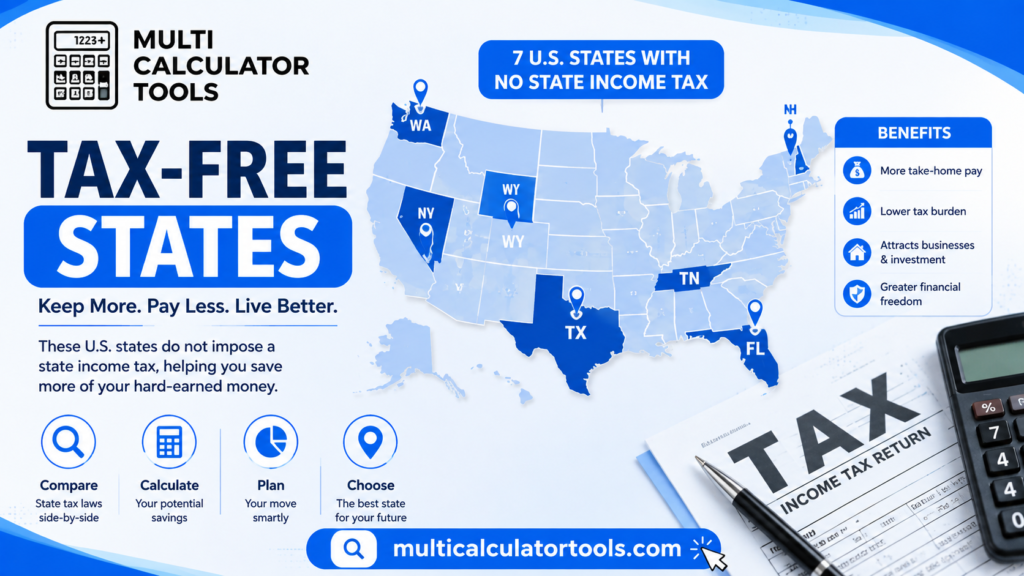
Now there are nine states that do not have a broad individual income tax. These nine states are Alaska, Florida, Nevada, New Hampshire, South Dakota, Tennessee, Texas, Washington and Wyoming. When people say “no income tax ” they are talking about money earned from wages and salaries. People living in these nine states still have to pay income tax. Also people living in these nine states usually pay local or state taxes, like property tax or sales tax to pay for things, like schools and roads.c
What Does “State Tax Free” Mean?
“State tax free” usually means a state that does not charge an individual state income tax. It does not mean that residents pay no taxes all. Residents of these states still owe income tax. Depending on the state they may also pay sales taxes, property taxes, excise taxes and other state or local taxes. The phrase points to the lack of one tax, not the lack of all taxes.
States With No Individual State Income Tax
| State | Individual Income Tax | Other Major Taxes to Consider | Key Note |
| Alaska | None | No state sales tax (local sales taxes up to ~7.5% in some areas); property tax varies by borough | No state sales tax, unusual among no-income-tax states |
| Florida | None | State and local sales tax; property tax | No individual income tax, estate, or inheritance tax |
| Nevada | None | Relatively high sales tax; property tax | Revenue also draws heavily on tourism-related taxes |
| New Hampshire | None | No state sales tax; relies heavily on property tax | Finished phasing out its tax on interest and dividends as of January 1, 2025 — now a full no-income-tax state |
| South Dakota | None | Sales tax; property tax | No corporate income tax either |
| Tennessee | None | Higher state and local sales tax; no tax on wage income | Former Hall income tax on interest/dividends was fully repealed |
| Texas | None | No state income tax; relatively high property tax | Sales tax and property tax fund most state and local services |
| Washington | No general wage income tax | 7% tax on long-term capital gains above roughly $270,000 (indexed annually, exemptions for real estate and retirement accounts); a new 9.9% tax on non-capital-gains income above $1 million takes effect January 1, 2028; higher sales tax | No longer a simple “no income tax” state for high earners — verify current thresholds before relying on this for planning |
| Wyoming | None | Sales tax; property tax | No corporate income tax either |
Figures such as sales tax rates and thresholds change and should be verified against the applicable state’s Department of Revenue before making financial decisions.
State-by-State Tax Overview
AlaskaThis place has no income tax. It is also quite unusual, for a state because there is no sales tax even though local areas can still charge their own sales tax. Property taxes change a lot depending on which borough you live in.
Florida The state has no income tax, no estate tax and no inheritance tax. State and local sales taxes, with property taxes serve as the main funding sources.
NevadaThe state has no income tax. The state draws heavily on sales tax and tourism‑related revenue including taxes tied to its gaming and hospitality industries.
New HampshireThe state finished phasing out its tax on interest and dividends on January 1 2025. Now the state is a no‑individual‑income‑tax state instead of an exception. The state has no state sales tax. The state relies heavily on property tax revenue.
South DakotaIt does not have any income tax or corporate income tax. The state government gets most of its money from sales tax and property tax.
TennesseeTax is not applied to wage income. The old Hall tax, which used to tax interest and dividend income has been fully repealed. The state has a high combined state and local sales tax rate.
Texas Texas has no income tax and depends a lot on property tax and sales tax income. Property taxes in Texas can be much higher than the average, in the country.
Wyoming The state does not have an income tax or a corporate income tax. Instead the state relies on sales tax, property tax and money from the mineral and energy industries to pay for things.
Are These States Really Tax-Free?
I think not. A state can have no individual income tax while still collecting revenue through sales tax, property tax, excise tax, business tax, fee and other sources. States, without an income tax generally make up that revenue elsewhere. Through higher sales tax or property tax. So the absence of one tax does not mean the absence of taxation overall.
Federal Taxes Still Apply
Living in a state with no income tax does not affect your federal tax obligations. Federal income tax, Social Security tax Medicare tax are calculated under rules and apply the same way no matter which state you live in. A resident of a no-income-tax state still owes income tax, on their taxable income and still has FICA taxes withheld from their paycheck.
Other Taxes to Consider
Sales Tax
A lot of states that do not charge income tax depend more on sales tax to pay for things. The total sales tax rates from both the state and local levels change a lot from place to place. For example Tennessee and Nevada usually have combined sales tax rates. On the hand Alaska and New Hampshire do not have any state sales tax at all though some local towns in Alaska might charge their own sales tax. You should check with each state revenue department to find the sales tax rates because local sales tax rates can make a big difference, in the total amount you pay.
Property Tax
A state that does not have income tax can still have large property taxes. Texas and New Hampshire for example are known for high property tax burdens compared to home value even though these states have no income tax. The actual property tax rate depends on home value, local assessment rules and any homestead exemptions that exist so it is worth comparing especially for people who own homes.
No-Income-Tax States for Retirees
States that do not charge income tax might look great, to people who are retired. However looking at the lack of an income tax does not tell the whole story. You should think about these things:
- Social Security taxation: None of the nine states that have no income tax tax Social Security benefits, at the state level.. Most other states do not tax Social Security benefits at this point.
- Pension and retirement-account withdrawals: These generally are not taxed at the state level in a no-income-tax state because there is no income tax to apply.
- Property taxes:The impact can still be significant in states, like Texas and New Hampshire.
- Sales taxes: Affect retirees on fixed incomes differently depending on spending patterns.
- Estate and inheritance taxes:Most of these nine states do not impose them but rules can change so one should verify the status for the specific state.
Retirees should look at the tax and cost‑of‑living picture instead of only relying on income‑tax status because Retirees need to see all taxes and all living costs not just income‑tax status.
What to Consider Before Moving
Before relocating to a no-income-tax state, it’s worth comparing more than the headline tax status:
- Whether. Not you have to pay state income tax
- Federal income tax, which stays the same regardless of state
- The rates for sales tax
- Property tax rates and home values
- How much housing costs and the general cost of living
- The cost of insurance
- How many employment opportunities are in the area
- Local taxes and fees
- The rules, for residency and domicile requirements
Simply owning a home or spending some time in a state does not automatically set or end tax residency.. Residency rules, including how many days you spend in a state and where home is considered permanent differ by state and can be more complicated than they first appear. Check the rules of the state you are thinking about or consult a qualified tax professional before making residency decisions, for tax purposes.
Common Misconceptions
“No state income tax means no taxes.” False — these states still collect revenue through sales tax, property tax, and other sources.
“You don’t pay federal income tax if your state has no income tax.” False — federal income tax applies the same way regardless of your state of residence.
“Every dollar earned is tax-free in these states.” Misleading — while wages generally aren’t subject to state income tax, some states (like Washington) do tax specific types of income, such as large capital gains.
“Moving to another state automatically changes your tax residency.” Not necessarily — establishing or ending residency and domicile involves specific state rules, not just a change of address.
“The state with no income tax is always the cheapest state.” Not necessarily — total tax burden and cost of living, including housing, property tax, and sales tax, matter just as much.
Common Mistakes
- People often mix up “no state income tax” with “no taxes all”
- They forget about local taxes and fees that can really add up
- They don’t take property taxes into account when looking at different states
- They miss out on sales taxes especially for families that spend a lot
- They use old information about states like New Hampshire, Tennessee or Washington
- They think all retirement income is automatically tax-free
- They believe investment income is treated the same, as wages (Washington’s different)
- They don’t pay attention to residency and domicile rules when planning to move
- They look at headline tax rates but don’t consider their income
- They only focus on state tax status and not the total cost of living
How to Compare Your Potential Tax Burden
A states total tax burden changes based on things like income spending. If you own a home. This means that just looking at a list of no-income-tax states does not give you the picture, for your own family. If you want to compare states you should use an income tax calculator or a take-home pay calculator. Using an income tax calculator or a take-home pay calculator can help you see how different state tax rules change your paycheck. You should also look at property tax and sales tax before you make a choice.
Suggested Internal Links
- State Tax Calculator → Compare estimated state tax outcomes
- Income Tax Calculator → Federal income tax-specific estimates
- Take-Home Pay Calculator → Full net-pay estimate tool
- Salary Calculator → Gross salary conversion tools
- Cost of Living Calculator → Compare living costs between states
- Retirement Calculator → Retirement income and savings planning
Relevant External Source Opportunities
- IRS. Income tax rules that apply no matter what state you live in.
- Official state Departments of Revenue from Alaska, Florida, Nevada, New Hampshire, South Dakota, Tennessee, Texas, Washington and Wyoming. State tax rules that’re current.
- Tax Foundation. Research that compares tax rates across states.
- Federation of Tax Administrators. A reference guide, for state tax administrators.
Tax Disclaimer
Tax laws and state rules can change. This article provides educational information and is not individualized tax or legal advice. I recommend you verify rules, with the applicable state tax agency and the IRS especially before moving or changing tax residency.
Conclusion
Tax-free state” is a way to say a state that does not have a general income tax for individuals. Not a state where people pay no taxes at all. Nine states are like this now: Alaska, Florida, Nevada, New Hampshire, South Dakota, Tennessee, Texas, Washington and Wyoming.. Washington is starting to tax big capital gains and will also tax very high non-capital gains income in 2028. Federal taxes are still required no matter where you live. States that do not have an income tax usually get their money from sales tax, property tax or other ways to collect money. If one of these states is better for your money depends on your income, your spending and your housing situation. A take-home pay or income tax calculator, on MultiCalculators.com can help you see situations using your own numbers.
FAQs
Nine states do not have an individual income tax and those states also avoid a broad individual income tax: Alaska, Florida, Nevada, New Hampshire, South Dakota, Tennessee, Texas, Washington and Wyoming.
No. These states usually get their money from sales tax, property tax, excise taxes and other ways than using a broad individual income tax.
Yes. Federal income tax works the way no matter which state you live in. Your state tax status does not change how you handle your income tax.
No. Texas does not have an income tax but has relatively high property taxes.
I think there is no answer. It depends on income level, homeownership, spending habits and other individual circumstances since states, without income tax often have higher sales or property taxes to compensate.
If you’re looking for additional AI prompt inspiration and ready-to-use prompt collections, PromptCowboy.ai is another valuable resource worth exploring. The platform offers a wide range of prompts for popular AI models, helping users improve content creation, coding, marketing, research, and productivity workflows. Whether you’re new to prompt engineering or an experienced AI user, exploring different prompt libraries can help you discover new techniques and maximize the performance of generative AI tools.