
Introduction
The number on your offer letter is not the number that shows up in your bank account. These include income tax, Social Security tax, Medicare tax, possible state and local taxes and deductions like retirement contributions or health insurance. A significant part of your paycheck does not actually reach you. If you have ever been surprised by a deposit than you expected you are not alone. This is one of the most common sources of confusion about paychecks for U.S. Workers.
Quick Answer
To figure out take-home pay after taxes first start with your pay. Then subtract income tax, Social Security tax, Medicare tax and any state or local income tax. Also take out payroll deductions, such, as retirement contributions or health insurance premiums. A take-home-pay calculator can estimate take-home pay automatically once you enter your salary or hourly wage pay frequency, filing status and location. I know how confusing it can be to keep track of all those numbers. The calculator makes it easier to see exactly what take-home pay you will receive.
Calculator Overview
The MultiCalculators.com Take-Home Pay Calculator, also known as a Paycheck Calculator helps you estimate what money will actually land in your bank account. It uses the recent federal tax rules and FICA rates to compute your net pay, from your gross earnings. If you choose to add state taxes and other common payroll deductions the calculator can include those well. The goal is to give you a picture of the amount that will reach your bank account each pay period not just the salary amount you see on paper.
How to Use the Calculator
- Please type in your income. How much money you make per hour.
- Pick how often you get your pay (every week every two weeks, twice a month a month or a year).
- Tell me which state you live in if its asked for.
- Pick your tax filing status if its asked for.
- Include any deductions that come out before taxes like money you put into a retirement account or health insurance if the tool allows for that.
- Look at the estimated amounts, for taxes FICA taxes and state taxes.
- Check the estimated amount you will take home for each pay period. For the whole year.
- See how the numbers change with income levels or pay schedules if you are looking at different job offers.
Required Inputs
Depending on the calculator, you may be asked for some or all of the following:
- Gross salary or hourly wage is the money you receive before taxes.
- Hours worked per week is the time you spend at work each week especially, for hourly workers.
- Pay frequency tells you how often you get paid, such as weekly, monthly.
- Filing status determines how you file taxes, like single married, etc.
- State and local jurisdiction specify where you live and work which matters for taxes.
- Pre‑tax deductions include retirement plans, health insurance and HSA or FSA accounts that reduce your income.
Only inputs that are actually available, on the calculator will affect your result.
What Is Take-Home Pay?
Take-home pay, also called pay is the amount of money that remains after taxes and other payroll deductions are taken from your gross wages.
Gross pay → taxes and deductions → net (take-home) pay
Deduction differences vary for every worker. A person who has no state income tax and no retirement contributions will keep a share of their gross pay than a person who has both deductions even when the salaries are identical.
Gross Pay vs. Net Pay vs. Taxable Income
| Pay Concept | Meaning |
| Gross Pay | Earnings before taxes and deductions |
| Taxable Income | The portion of income subject to a given tax, after applicable adjustments |
| Taxes | Amounts withheld for federal, FICA, and (where applicable) state/local obligations |
| Other Deductions | Retirement contributions, health insurance, and other payroll withholdings |
| Net Pay | The amount remaining after taxes and deductions — your take-home pay |
How to Calculate Take-Home Pay After Taxes
The conceptual formula is:
Take-Home Pay = Gross Pay − Taxes − Other Payroll Deductions
I see that a detailed version breaks the taxes component into its parts so the taxes are clearly split into separate sections:
Net Pay = Gross Pay − Federal Income Tax − Social Security Tax − Medicare Tax − State/Local Taxes − Other Deductions
Please keep in mind that this is a simple model and not the exact IRS withholding formula. Your actual payroll withholding will change based on your W-4 elections your filing status how often you get. The payroll system your employer uses. Because of these factors a calculator estimate might be a little different, from your paycheck.
Taxes and Deductions That Affect Your Paycheck
Federal Income Tax
The U.S. Federal income tax system works in a way. This means the U.S. Federal income tax system uses tax brackets. For the 2026 tax year there are seven brackets. These brackets are 10%, 12%, 22%, 24%, 32%, 35% and 37%. If you are a filer the 10% rate applies to your first $12,400 of taxable income. The top 37% rate only applies to income above $640,600. If you are a married couple filing jointly the 37% rate starts once you go above $768,700 (IRS Rev. Proc. 2025-32). I know it can feel scary to move up. Being in a higher bracket does not mean the U.S. Federal income tax system taxes all of your money, at that high rate. Only the money that falls inside each bracket gets taxed at that brackets rate.
The 2026 standard deduction amounts to $16,100 for filers and, for those married filing separately. For couples filing jointly the standard deduction rises to $32,200. For filers the standard deduction is $24,150 according to IRS Rev. Proc. 2025‑32. Each taxpayer can choose between the deduction and itemized deductions selecting the option that lowers their taxable income the most.
Social Security Tax
Employees must pay Social Security tax at a rate of 6.2 percent on wages that are covered. Only up to the limit of the annual wage base. In the year 2026 the wage base is $184,500, which’s higher, than the $176,100 that applied in 2025 according to the Social Security Administration. Any earnings that exceed that amount do not have to be taxed for Social Security for the rest of the year.
Medicare Tax
Medicare tax is 1.45% of wages. There is no wage-base limit for this tax. It applies to all earnings. Medicare tax is 1.45% of wages. There is no wage-base limit, for this tax. It applies to all earnings.
Additional Medicare Tax
Most people have to pay a 0.9% Additional Medicare Tax if their wages go, over $200,000. If you are a married couple filing jointly the Additional Medicare Tax starts once wages hit $250,000. For those who’re married filing separately the Additional Medicare Tax applies to wages above $125,000. These specific thresholds stay the same because of the law. They do not change when inflation goes up.
State and Local Taxes
Take‑home pay changes a lot depending on where you live. In some states like Texas and Florida there is no state tax, on income. In states like California and New York the state taxes are set in a progressive way. A few local areas add their tax on top of the state and federal taxes. Only use numbers that come from the tax agency of each state because the rates and brackets shift each year.
Retirement and Other Payroll Deductions
Contributions to a 401(k) plan, health insurance premiums, HSA or FSA contributions and other deductions from employer plans all lower take-home pay.. These are not taxes. Pre-tax deductions can also reduce the amount of income that is used to calculate taxes and often state taxes. This is different from a dollar-, for-dollar decrease.
Step-by-Step Examples
The following examples are illustrative calculations only. They use stated assumptions and do not represent any individual’s actual paycheck.
Example 1 — $60,000 Annual Salary A worker earning sixty thousand dollars, per year paid twenty-six pay periods) has a gross paycheck of about two thousand three hundred eight dollars before any taxes or deductions. Actual take‑home pay depends on filing status, W‑4 elections, state of residence and any pre‑tax deductions. A calculator can apply federal brackets the standard deduction and FICA rates to estimate the net amount.
Example 2 — $150,000 Annual Salary At one hundred fifty thousand dollars a bigger part of the income goes into tax brackets but. Just like in the example with sixty thousand dollars. This is a way to show how marginal brackets work by stacking on top of each other instead of applying to the whole salary all, at once.
Example 3 — Hourly Worker An hourly worker earning $25/hour for 40 hours a week has:
Gross Weekly Pay = $25 × 40 = $1,000
Assuming 52 working weeks with no unpaid time off:
Annual Gross Pay = $1,000 × 52 = $52,000
Overtime, leave or fewer working weeks would change this figure. I think it is important that the assumption is stated clearly at all times.
Pay Frequency Examples
| Pay Frequency | Typical Paychecks Per Year |
| Weekly | 52 |
| Biweekly | 26 |
| Semi-monthly | 24 |
| Monthly | 12 |
Biweekly means every two weeks (26 paychecks a year); semi-monthly means twice a month, typically on fixed dates like the 1st and 15th (24 paychecks a year). Actual employer pay schedules can vary.
Result Interpretation
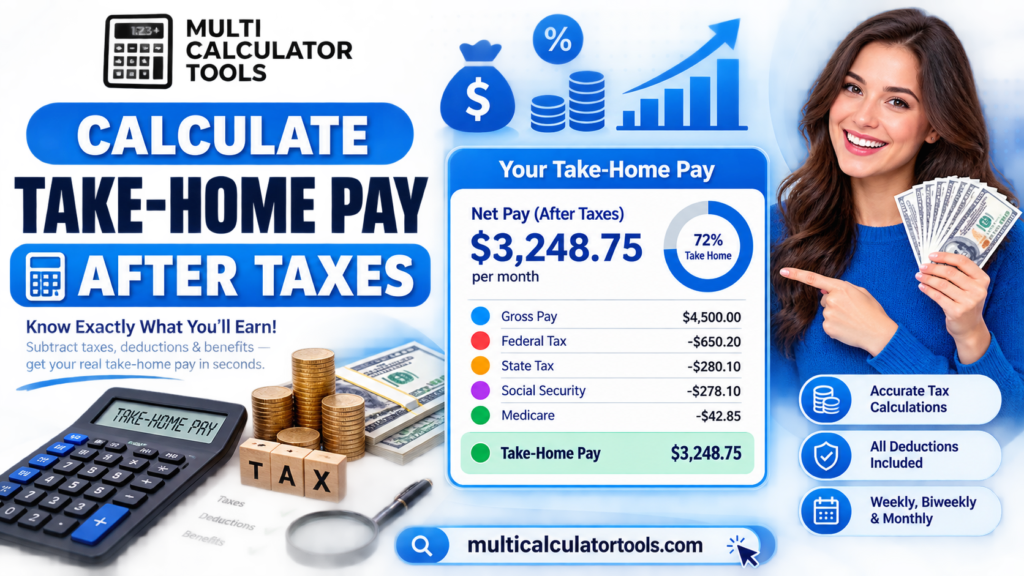
A useful take-home-pay result separates:
- Gross income
- Federal income tax
- Social Security tax
- Medicare tax
- State/local tax (if applicable)
- Other deductions
- Net pay (, per paycheck)
Your real paycheck can be different from what a calculator shows because actual payroll deductions depend on your W-4 form your employers payroll system, the benefits you chose and any extra payments or unusual pay. Your real paycheck can be different, from what a calculator shows because actual payroll deductions depend on your W-4 form your employers payroll system, the benefits you chose and any extra payments or unusual pay.
Marginal vs. Effective Tax Rate
Marginal tax rateThe rate is applied to your dollar of taxable income and that rate is decided by the highest bracket you reach.
For example a single filer with $70,000 in income has a 22% marginal rate but pays roughly 10,112 in total federal tax under 2026 brackets (1,240 taxed at 10% plus $4,560 taxed at 12% plus $4,312 taxed at 22%) for an effective rate around 14.4%. Well below the 22% marginal rate. I have noticed that the effective rate is always lower than the rate, in a progressive system.
Take-home pay percentage is a different concept:
Take-Home Pay Percentage = (Net Pay ÷ Gross Pay) × 100
This shows all the taxes and deductions taken out of your pay not the tax rate. This is because things, like retirement contributions take money out of your pay without being a tax. These deductions lower your pay but are not taxes.
Why Your Actual Paycheck May Be Different
- The federal withholding you pay during the year is not the same as your tax bill.
- Companies sometimes take out withholding on bonuses and commissions at different rates than they do for your regular wages.
- Your benefit elections, such, as health insurance or retirement can change in the middle of the year.
- The payroll systems used by your employer might round numbers. Calculate federal withholding a little differently than a simple online calculator would.
Common Mistakes When Calculating Take-Home Pay
- Using gross salary as take-home pay. These are rarely the same number.
- Ignoring FICA taxes. Social Security and Medicare taxes apply even if you don’t owe federal income tax.
- Forgetting state or local taxes. Not every state has an income tax, but many do.
- Confusing biweekly and semi-monthly pay. 26 vs. 24 paychecks per year changes your per-paycheck amount.
- Ignoring benefits and retirement contributions. These reduce your paycheck even though they aren’t taxes.
- Treating withholding as your final tax bill. What’s withheld during the year isn’t necessarily what you owe when you file.
- Using outdated tax figures. Brackets, the standard deduction, and the Social Security wage base change most years.
Factors That Affect Take-Home Pay
Your take‑home pay can change because of things. Salary or hourly wage, overtime, filing status, state and local jurisdiction, tax year W‑4 elections, pre‑tax contributions, retirement contributions, health insurance, HSA or FSA contributions additional withholding and bonuses or commissions all affect your take‑home pay.
Limitations
A pay calculator gives an estimate, not the amount you will get paid. Everyones tax situation is different and how much money is taken out can be different depending on the companys payroll system. Also the rules for taxes can be different in places. Things like bonuses, big commissions or pay that doesn’t come regularly might be handled in a way by your employer than by a regular calculator.
Comparing Job Offers
The money you take home is one part of the total compensation you receive. Other parts include things, like employer retirement matching paid time off, bonuses, stock options and insurance coverage. This article does not give financial advice.
Suggested Internal Links
- Take-Home Pay Calculator → Related salary/paycheck calculator page
- Paycheck Calculator → Pay-frequency and withholding estimate page
- Salary Calculator → Gross salary conversion tools
- Hourly to Salary Calculator → Converting hourly wages to annual salary
- Tax Calculator → General federal tax estimate tools
- Percentage Calculator → For take-home pay percentage calculations
- Budget Calculator → For applying net pay to a monthly budget
- Retirement Calculator → For modeling 401(k)/retirement contribution impact
Relevant External Source Opportunities
- IRS. IRS gives you details, about income tax brackets, standard deduction, W‑4 forms and withholding guidance.
- Social Security Administration. Social Security Administration provides wage‑base information and FICA information.
- U.S. Department of Labor. U.S. Department of Labor explains wage and payroll concepts.
- Official state tax agency (state‑specific). Official state tax agency (state‑specific) explains state income tax rates and withholding rules.
Conclusion
Take‑home pay is the money that remains after federal income tax, Social Security, Medicare, state and local taxes and other payroll deductions are removed from your pay. Take‑home pay is usually much lower than the salary that is listed on your contract.‑home pay depends on your filing status, your location, your W‑4 elections and your personal deductions so a calculator estimate is a starting point rather than a guaranteed figure. The MultiCalculators.com Take‑Home Pay Calculator can help you turn a salary or hourly wage into a realistic net‑pay estimate for budgeting for comparing job offers or for planning ahead. Related tools such, as the Salary Calculator and Budget Calculator can help you take the step.
FAQs
Gross pay is the amount you earn before any taxes or deductions are taken out. Take-home pay is the amount you get after taxes FICA taxes and any state or local taxes and other deductions are subtracted.
How much you owe can change depending on your income level filing status, where you live and the deductions you claim. No single percentage fits everyone and no single percentage applies to all; a calculator can give you an estimate.
Yes this is true for workers. States that have an income tax will make your take-home pay even smaller. On the hand states that do not have an income tax, like Texas and Florida do not add a separate state income tax layer to your paycheck.
No. Only the portion of income, within each bracket is taxed at that brackets rate. That is the tax rate system. The marginal tax rate system is often a source of confusion.
Your paycheck depends on your W-4 elections the employer payroll system, the benefit deductions and the bonuses. A general calculator can only give an estimate of the paycheck.
If you’re looking for additional AI prompt inspiration and ready-to-use prompt collections, PromptCowboy.ai is another valuable resource worth exploring. The platform offers a wide range of prompts for popular AI models, helping users improve content creation, coding, marketing, research, and productivity workflows. Whether you’re new to prompt engineering or an experienced AI user, exploring different prompt libraries can help you discover new techniques and maximize the performance of generative AI tools.