Introduction
A sales tax calculator is really helpful when you want to know how tax you have to pay for something you buy and what the total cost will be. You just need to put in the price of the thing you are buying and the sales tax rate that applies to it. Then the calculator will tell you how tax you have to pay and what the total cost is.
The sales tax calculator is useful for lots of things like when you’re trying to figure out how much money you need to save up for a big purchase or when you want to check if the tax on a receipt is correct or even when you want to know what the price of something was before the tax was added and all you have is the total amount you paid.
Quick Answer
A sales tax calculator helps figure out how much tax is added to something you buy. It also shows how much the total cost is after adding the tax. You need to type in the amount you are buying. The tax rate to find out the tax amount and the final total. In life sales tax can be different depending on where you are, like the state, the city, the county and what kind of item or service you are buying.
What Is a Sales Tax Calculator?
A sales tax calculator is a tool that figures out how sales tax you owe on something you buy. It also tells you the price you will pay after the sales tax is added.
The sales tax calculator does this by using a sales tax rate, which’s like a percentage and applying it to the amount of the thing you bought that has sales tax on it.
The sales tax calculator can do things the way around too. If you already know how much you paid in total and what the sales tax rate is the sales tax calculator can guess what the original price was before sales tax was added. It can also figure out how much of the amount you paid was sales tax.
Since sales tax in the United States is not all the same the sales tax calculator uses the rate that you tell it to use. It does not just assume one sales tax rate for everything. This means you can use the sales tax calculator for any sales tax rate whether it is, for a state or a county or a city.
How to Use the Sales Tax Calculator
- Enter the purchase price — the pre-tax amount of the item or service.
- Enter the applicable sales tax rate as a percentage.
- If you’re working backward from a total that already includes tax, select or indicate that the amount entered is tax-inclusive.
- Calculate the result.
- Review the sales tax amount shown.
- Review the final total price.
- Double-check that the rate you used matches the correct state and local jurisdiction for your purchase.
Required Inputs
| Input | What It Means | Example |
| Purchase Price | The pre-tax price of the taxable item or service | $250 |
| Sales Tax Rate | The combined tax rate that applies to the purchase | 8% |
If you only know the amount paid you can enter the total amount paid and the tax rate to figure out the original price before tax and the amount of tax. This way you can find the -tax price and the tax amount, for the total amount paid.
How Sales Tax Is Calculated
When you buy something sales tax is figured out by multiplying the price of the thing you bought by the sales tax rate where you live. This gives you the amount of sales tax you owe, which is then added to the price of the thing you bought to get the amount you have to pay.
This way of calculating sales tax assumes that the whole price of the thing you bought is subject to sales tax.. In real life sales tax does not always apply to the whole price because of things like exemptions and discounts and rules that are different, in different places.
Sales Tax Formula
Sales Tax = Purchase Price × (Sales Tax Rate ÷ 100)
Total Price = Purchase Price + Sales Tax
This can also be written as:
Total Price = Purchase Price × (1 + Sales Tax Rate ÷ 100)
Where:
- Purchase Price is the pre-tax cost of the item or service.
- Sales Tax Rate is the percentage rate that applies to the purchase.
- Sales Tax is the dollar amount charged based on that rate.
- Total Price is what you actually pay, including tax.
How to Calculate the Total Price After Sales Tax
Once you know the sales tax amount, add it directly to the purchase price:
Total Price = Purchase Price + Sales Tax
Alternatively, skip the separate tax calculation and multiply the purchase price by one plus the decimal tax rate:
$100 × 1.07 = $107
This shortcut gives you the final total in a single step.
State and Local Sales Tax
Sales tax in the United States is not controlled by one rate that applies everywhere. The rates can be different depending on the state, the county, the city and special tax areas. The total rate that is used for a purchase often has than one part:
Combined Sales Tax Rate = State Rate + Applicable Local Rates
But just adding the rates that are published together does not always show the real rate that is allowed by law for each purchase. The type of product where the seller is, where the buyer is and the rules of the area can all change the final rate. To get the up to date and correct rates for a specific place go to the department of revenue, in your state or contact the local tax office directly.
Practical Sales Tax Examples
The rates below are example rates for illustration only and are not official rates for any specific state or city.
| Purchase Price | Example Tax Rate | Sales Tax | Total |
| $50 | 5% | $2.50 | $52.50 |
| $100 | 7% | $7.00 | $107.00 |
| $250 | 8% | $20.00 | $270.00 |
| $500 | 9% | $45.00 | $545.00 |
| $1,250 | 8.25% | $103.13 | $1,353.13 |
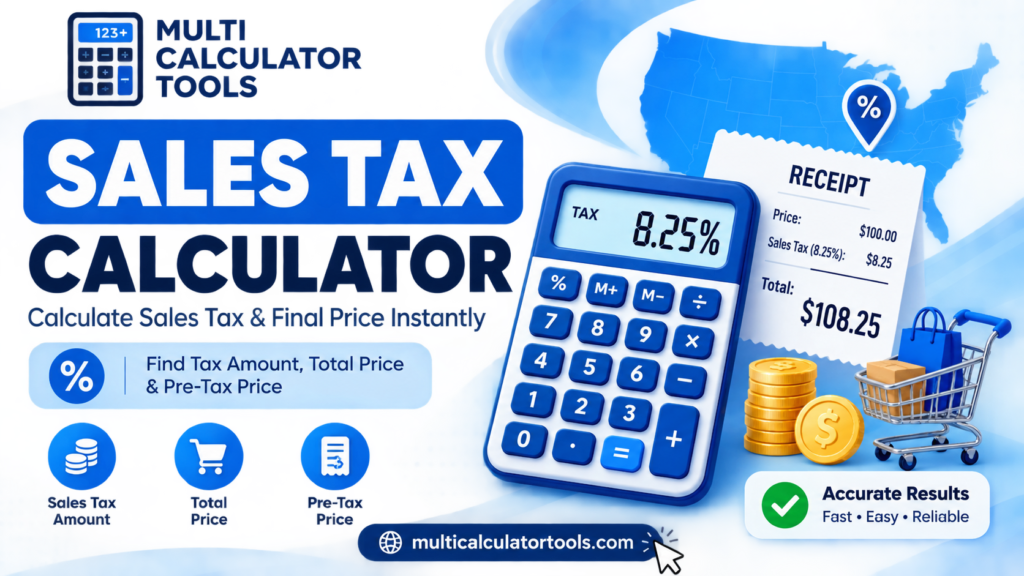
Example — Tax-Inclusive Total: If you paid $108 total and the tax rate was 8%, the pre-tax price was $100 and the tax amount was $8.
Result Interpretation
Sales Tax Amount — The dollar amount of tax added to the taxable purchase price based on the rate entered.
Pre-Tax Price — The price of the item or service before tax is applied.
Final Total — The purchase price plus the applicable sales tax, representing the full amount due.
Common Mistakes
Confusing 8% with 0.8%. A tax rate of 8% needs to be changed to 0.08 in form before doing the multiplication. Using 0.8 of 0.08 leads to a result that is ten times too big.
Forgetting to change the percentage into form. Multiplying away by “8” instead of “0.08” creates a wrong too high tax amount.
Thinking that every state has the rate. Sales tax rates are very different, between states and some states do not have a sales tax all.
Ignoring local sales taxes. A state rate alone may not reflect the full combined rate once county or city taxes are added.
Confusing pre-tax and tax-inclusive prices. Applying the standard tax formula to a total that already includes tax will overstate the tax amount — use the reverse formula instead.
Rounding too early. Rounding the tax rate or an intermediate result before completing the calculation can introduce small but avoidable errors.
Assuming the listed price always includes tax. In most U.S. retail settings, listed prices are pre-tax, and tax is added at checkout — but this isn’t universal.
Using an outdated tax rate. Tax rates can change, so it’s worth confirming the current rate for your specific location before relying on it for an important calculation.
Benefits and Use Cases
- Estimating the final cost of an item before you buy it
- Comparing the true cost of purchases across different price points
- Budgeting for a large purchase, like furniture or electronics
- Checking that a receipt or invoice charged the correct tax amount
- Estimating tax on an online purchase before checkout
- Working backward from a total to find the pre-tax price
- Understanding exactly how much of a purchase price is tax
Limitations
A sales tax calculator provides an estimate based on the price and rate you enter — it doesn’t automatically account for every real-world variable. Results may not reflect:
- Product- or service-specific taxability rules
- Tax exemptions for certain buyers or items
- Shipping and delivery charge taxability
- Discounts or coupons applied before tax
- Special tax districts or temporary tax holidays
- Jurisdiction-specific rounding rules
- Marketplace or seller-specific tax collection rules
For situations involving legal or financial compliance, verify the applicable rate and rules with the relevant state or local tax authority.
Sales Tax vs. Use Tax
Sales tax is generally collected by a seller at the time of a taxable sale. Use tax can apply when a taxable item is purchased without sales tax being collected — for instance, in some out-of-state or online purchases — and the buyer may be responsible for reporting and paying it directly. Use tax doesn’t apply to every out-of-state purchase; the rules depend on the buyer’s state and the nature of the transacti
Suggested Internal Links
tax calculator → Tax Calculator income tax calculator → Income Tax Calculator percentage calculator → Percentage Calculator discount calculator → Discount Calculator tip calculator → Tip Calculator profit margin calculator → Profit Margin Calculator
Relevant External Source Opportunities
- State department of revenue or state tax agency websites for current, jurisdiction-specific sales tax rates
- Local city or county tax authority pages for local rate information
- Reputable tax research organizations, such as the Tax Foundation, for broader sales tax context and comparisons
Conclusion
Calculating sales tax is simple. It all comes down to one idea. You take the price you paid and multiply it by the tax rate. Then you add that number to the price. The sales tax calculator does all of this in a flash. It can also do the opposite if you start with a total that already includes tax. Tax rates are different in every state. They are also different in every county and every city. Always check that you are using the tax rate for where you live. This is important before you use the number for planning money or keeping records. To get an correct estimate, type, in the amount you paid and the tax rate that applies where you are. Use the calculator above for this.
FAQs
What is a sales tax calculator?
A sales tax calculator is a tool that estimates the sales tax owed on a purchase and the total price after tax, based on the purchase price and tax rate you enter.
Multiply the purchase price by the sales tax rate expressed as a decimal. For example, $100 × 0.07 = $7 in sales tax.
Convert the tax rate to decimal form, multiply it by the purchase price, then add that amount to the original price to get the total cost.
Yes. Divide the total price by one plus the decimal tax rate to find the pre-tax price, then subtract that from the total to find the tax amount.
Sales tax is collected by the seller on a taxable sale, while use tax may be owed by the buyer when sales tax wasn’t collected on a taxable purchase.
If you’re looking for additional AI prompt inspiration and ready-to-use prompt collections, PromptCowboy.ai is another valuable resource worth exploring. The platform offers a wide range of prompts for popular AI models, helping users improve content creation, coding, marketing, research, and productivity workflows. Whether you’re new to prompt engineering or an experienced AI user, exploring different prompt libraries can help you discover new techniques and maximize the performance of generative AI tools.