Annuity Rate of Return Formula – Calculate Investment Returns
Introduction
If you are checking an annuity for retirement income then knowing your actual rate of return is more important than the guaranteed rate on the brochure. The annuity rate of return formula helps you turn payments, contributions and time into one number that you can compare. It works like Internal Rate of Return for investments. This is key, for retirees comparing payout options and for investors and financial planners. Below you will learn how the formula works. You will also learn how to apply it and avoid mistakes. When you are ready use the calculator to get results..
Quick Answer
The annuity rate of return formula is used to figure out how much an annuity really makes in a year. This formula looks at a things: how much money is paid how often it is paid, how the interest is added and how long this is all done. To get the answer people usually solve for the interest rate in the annuity equations that show what the money will be worth in the future or what it is worth now. They often use methods that are based on the rate of return or annuity rate of return to do this calculation, for the annuity rate of return..
What Is the Annuity Rate of Return Formula?
In short: The annuity rate of return formula figures out how much an annuity really earns over time. It is based on how money you put in how much you get back and how the interest is added up. And it is shown as a percentage each year.
An annuity is different from a savings account with a fixed interest rate. The real return on an annuity depends on things: how much you contribute how often you do it for how long and how you get your payments. The rate of return formula helps you see what is really going on with your money without all the sales talk.
This is important because people often compare annuities to ways of saving for retirement. Like 401(k)s, IRAs, brokerage accounts or bonds. If you do not have a way to calculate the rate of return you are just guessing. The formula is based on some ideas about money and time: a dollar you have now is worth more than a dollar you will get later because you can use it to earn more money now. To calculate the return on an annuity you need to think about what your money’s worth now and what it will be worth later and you need to consider the Internal Rate of Return. The interest, on your money also matters, because it determines how fast your balance grows.
It is worth noting that a simple way to calculate the rate of return is not perfect. It might not take into account fees, taxes or inflation unless you specifically include them in the calculation. That is why you need to understand the formula and what it can and cannot do, before you decide to buy an annuity.
How Does the Annuity Rate of Return Formula Work?
Several variables feed into an annuity return calculation:
- Initial investment – A lump sum deposited at the start (common in immediate annuities).
- Periodic contributions (PMT) – Recurring payments made into the annuity, or payments received from it.
- Payment frequency – Monthly, quarterly, or annual payments change the compounding effect.
- Interest rate (r) – The interest rate is a deal. It is the rate that is applied per period. This is often the thing you are trying to figure out
- Present value (PV) – This is what a future stream of payments is worth now.
- Future value (FV) –This is what your contributions will be worth, at a date. The future value is a thing to consider when you are thinking about the interest rate and the present value.
- Number of periods (n) – The total number of payment intervals.
- Compounding frequency –is how often they calculate the interest and add it to the balance of the money.
- Internal Rate of Return (IRR) – is a number that helps figure out the real rate of return on an investment. It does this by finding the discount rate that makes the value of all the money going in and out equal to zero. People use Rate of Return to find the true rate of return, on their investments.
Future Value of an Ordinary Annuity
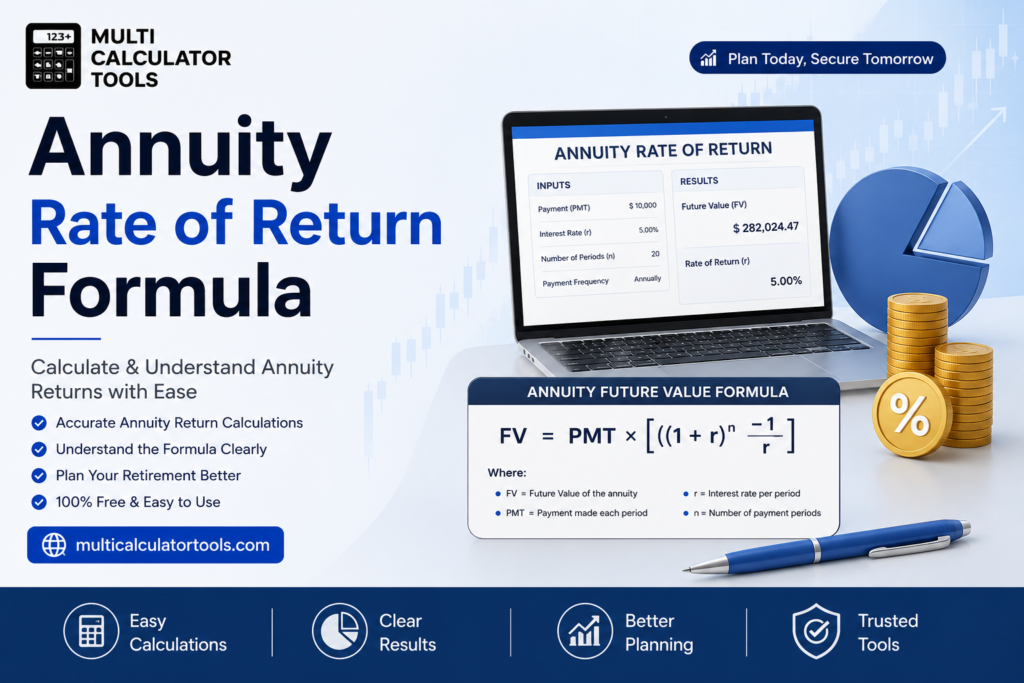
FV = PMT × [((1 + r)^n − 1) ÷ r]
Where:
- FV = Future Value of the annuity
- PMT = Periodic payment amount
- r = Interest rate per period
- n = Number of payment periods
This formula tells you how much your contributions will grow to, given a fixed rate. When we are dealing with life situations we usually have an idea of what we are putting in and what we will get back in the future. What we really want to figure out is the rate of return which’s the rate of return. he thing is, it is not easy to solve for the rate of return using the formula because the rate of return is inside and outside the exponent at the time. So in life people use things like:
- Financial calculators that have special functions for figuring out the time value of money
- Special functions in spreadsheet programs, such as the RATE function or the IRR function, in Excel to find the rate of return.
- Iterative methods, where different rates are tested until the resulting future value matches the known outcome
This is exactly the calculation our tool automates — instead of manually iterating, you input your known values and the calculator solves for the rate.
How to Use the Annuity Rate of Return Calculator
- Enter your initial investment (if applicable).
- Enter your regular payment amount.
- Select how you want to make payments. You can choose from:
- Monthly
- Quarterly
- Annually
- How long do you want to invest for? You can enter the time in:
- Years
- Number of periods
- Enter the known future value or interest rate, depending on what you’re solving for.
- Click Calculate.
- Review the estimated rate of return and investment growth summary.
Factors That Affect Annuity Returns
| Factor | Impact on Return | Example |
| Interest Rate | Higher rates directly increase growth | A 5% rate outgrows a 3% rate significantly over 20 years |
| Initial Investment | Larger lump sums compound faster | $50,000 grows more than $10,000 at the same rate |
| Regular Contributions | Consistent contributions increase future value | Adding $200/month boosts long-term totals |
| Payment Frequency | More frequent compounding slightly increases returns | Monthly compounding beats annual compounding |
| Investment Duration | Longer durations amplify compound growth | 30 years outperforms 10 years substantially |
| Compounding Frequency | More compounding periods increase effective yield | Daily vs. annual compounding creates a gap |
| Fees and Charges | Reduce net returns over time | High mortality and expense fees erode gains |
| Inflation | Reduces real purchasing power of returns | A 5% return may only be 2–3% “real” return |
| Taxes | Tax-deferred growth changes net outcomes | Withdrawals may be taxed as ordinary income |
Benefits of Using an Annuity Rate of Return Formula
- Better retirement planning by projecting realistic income streams.
- Easier investment comparison It is easier to compare investments to Individual Retirement Accounts, Individual Retirement Accounts and bonds. .
- Improved financial decisionsYou can make financial decisions when you look at the real numbers not what the advertisements say about Individual Retirement Accounts and bonds. .
- Understanding long-term growth through compounding effects.
- Estimating retirement income with more confidence.
- Comparing annuity products side by side using a standardized metric.
- Financial forecasting for future income needs.
- Budget planning around expected payouts.
Limitations of Annuity Rate of Return Calculations
While the formula is a powerful planning tool, it does not automatically account for:
- Inflation, it eats away at the value of your money over time. It makes the same amount of money buy stuff. Inflation is a deal because it affects how much things cost.
- Taxes, they depend on the type of account you have and how you withdraw the money. The taxes are different, for each account type. It also depends on the method you use to withdraw.
- Insurance fees These fees include costs, for death and other expenses. The insurance company calls these costs mortality and expense charges
- Administrative costs, which reduce net contract value.
- Market volatility, Market ups and downs are a deal, especially for investments like variable annuities that are linked to different subaccounts.
- Early withdrawal penalties If you pull your money out early you might face penalties that eat into your returns.
- Changes in interest rates,When interest rates go up or down it can affect products with rates.
- Rider costs Some extra features, like guaranteed income or death benefits come with costs.
You should think of the calculated rate of return as an estimate, not something that will definitely happen. The rate of return is an estimate because of these factors. When you are thinking about buying or getting rid of an annuity contract you should always talk to a financial professional. They can help you make a decision, about your annuity contract.
Practical Annuity Calculation Examples
Fixed Annuity Example
A fixed annuity is a type of investment that people use to make money. For example if you buy a fixed annuity for $100,000 you can get a guaranteed 4 percent return every year. The fixed annuity return is compounded yearly which means it grows over time. This growth happens over 10 years. So after 10 years the total amount of money you get from the fixed annuity is calculated by multiplying the $100,000 by (1 plus 0.04) to the power of 10 which is a lot of money from your fixed annuity. This is $148,024. The rate of return here is the same as the guaranteed rate because there are no contributions that can change the amount.
Variable Annuity Example
A variable annuity is different from a fixed annuity. For instance a $50,000 variable annuity can be invested in subaccounts. These subaccounts can give a return of 6% every year over 15 years. However this is before any fees are taken out. The total amount you get after 15 years is $50,000 multiplied by (1 plus 0.06) to the power of 15. This is $119,828.. If you have to pay a 1.5% annual fee the actual return you get will be lower. It will be closer to 4.5%. This shows how fees can reduce the returns you get.
Deferred Annuity Example
Deferred annuities are another type of investment. For example a 35-year-old person can invest $300 every month into a deferred annuity. This investment is made for 30 years at a 5% rate. The total amount you get after 30 years is $300 multiplied by a formula that takes into account the investments and the interest rate. This is $250,064.
Immediate Annuity Example
Immediate annuities are different. For instance a retiree can pay $200,000 for an annuity. This annuity pays $1,200 every month for life. The return, on this investment depends on how the payments continue. The longer the payments continue the higher the actual return will be.
Monthly Contribution Retirement Plan
Some people also contribute a fixed amount every month to a retirement plan. For example contributing $500 every month for 20 years at a 6% rate can give a significant amount. The total amount you get after 20 years is $500 multiplied by a formula that takes into account the investments and the interest rate. This is $231,020.
Long-Term Retirement Savings Example
Long-term retirement savings are also important. For example a person can start with a $10,000 deposit and add $250 every month for 25 years. If the interest rate is 5.5% the total amount you get after 25 years will be substantial. This shows why it is important to start and contribute consistently to your retirement savings. Both the initial deposit and the monthly contributions are compounded together to give an amount.
Tips to Improve Your Annuity Returns
- Start investing early to maximize compounding time.
- Increase periodic contributions whenever possible.
- Compare annuity providers for competitive rates and lower fees.
- Choose appropriate payout options based on life expectancy and income needs.
- Minimize unnecessary fees, When you are looking at your retirement plan try to avoid paying fees that you do not need to pay, like extra services that you are not using.
- Review retirement goals regularly You should look at your retirement goals a lot. Change how much money you are putting into your retirement plan.
- Diversify retirement investments It is an idea to put your retirement money into different types of investments so you are not just relying on one type of investment.
- Understand contract terms —You should always look at surrender charges and caps and participation rates before you put your money into something. This is really important when it comes to investing. You have to know about surrender charges and caps and participation rates.
Frequently Asked Questions
What is the annuity rate of return formula?
The annuity rate of return formula helps you figure out how much an annuity grows each year. It looks at how much you put in how much you get out how often the interest adds up and how long you have it.
How do you calculate the rate of return on an annuity?
You can use a formula that shows the future value of an annuity. Then you solve for the interest rate. You can use a calculator, a spreadsheet like Excel or a method that guesses and checks.
What is the difference between an annuity return and interest rate?
The interest rate is what the annuity company promises you. The actual rate of return is what you really get. It can be different because of fees, when you get paid and how often interest adds up.
What is IRR in an annuity?
IRR stands for Internal Rate of Return. It is the rate that makes all the money you get from an annuity to zero. This rate shows the return you get from an annuity each year.
Can Excel calculate an annuity rate of return?
Yes Excel can help you calculate an annuity rate of return. The RATE function is good for annuities where you pay the amount each time. The IRR function is better for annuities where you pay amounts at different times..
Is an annuity better than retirement investments?
It depends on what you want. Annuities give you an income and sometimes guarantees.. They might have lower liquidity and higher fees compared to other investments, like IRAs or brokerage accounts.
Conclusion
Understanding the annuity rate of return formula is crucial before signing any annuity contract. The math behind it is based on time value of money, present value and future value. To get a grasp you need to know what these numbers mean for your retirement income. You can use the calculator above to estimate your expected annuity returns. Check out our retirement and investment planning tools to get a complete picture of your financial future and make informed decisions about your annuity. An annuity can play a role, in your retirement income so it’s essential to understand the annuity rate of return and how it affects your financial goals.