Introduction
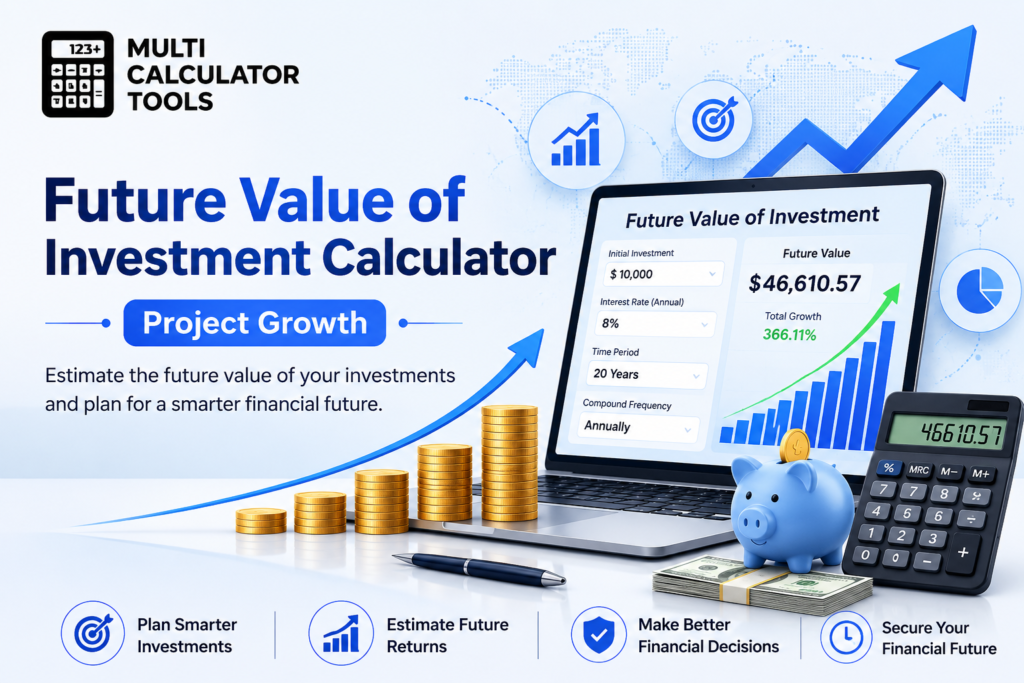
The Future Value of Investment Calculator estimates how much your investment could grow based on your initial amount, regular contributions, expected return, investment period, and compounding frequency. It helps investors, retirement planners, students, and financial advisors compare savings goals and investment strategies. Enter your details to see your projected investment growth.
Quick Answer Box
A Future Value of Investment Calculator estimates how much your investment could grow over time using your initial investment, regular contributions, expected return, and compound interest. It helps you plan for retirement and other financial goals, but the results are estimates and do not guarantee future returns.
What Is a Future Value of Investment Calculator?
A Future Value of Investment Calculator is a tool that helps you figure out how much an investment will be worth in the future. It does this by looking at how much you start with how much you add to it what kind of return you expect to get. How long you plan to keep the money invested. The Future Value of Investment Calculator uses the idea that money can grow faster when you put the money you earn back into the investment.People who invest use the Future Value of Investment Calculator to turn goals like saving for retirement or building a college fund into a real number they can work towards. There are a few things that affect what the Future Value of Investment Calculator says your investment will be worth. These are:
• Principal, which’s the initial investment. This is the money you start with if you have any.
• Regular contributions. This is the money you add to your investment each month, quarter or year.
• Expected rate of return. This is how much you think your investment will grow each year.
• Compounding frequency. This is how often the interest on your investment is added to the amount.
• Investment period. This is how long you plan to keep your money invested.
• Inflation. You can also choose to adjust for inflation, which means the Future Value of Investment Calculator will show you what your investment will be worth in today’s money.You should remember that the Future Value of Investment Calculator is just making an educated guess. It is not a promise of how your investment will do. The Future Value of Investment Calculator is based on assumptions. Real investments can be affected by what is happening in the market and that can be very different, from what you expect.
How Does the Future Value of Investment Calculator Work?
The calculator uses a formula to figure out how your money will grow over time. It takes into account the money you start with and any extra money you add along with how you think you will earn each year and how often the earnings are added to your total. Then it tells you how money you will have at the end of the time you choose to invest.
Compound interest plays a major role in growing your investments over time. A Future Value of Investment Calculator helps you project future returns and compare different investment strategies. For additional insights into calculating future investment growth, visit Future Value of Investment Calculator – Project Growth.
Here is what each part of the calculator does:
• investment. This is the money you start with. It grows on its own as time goes by even if you do not add any more money.
• contributions. These are the extra deposits you make like every month or every year. They also grow over time.
• Expected return. This is how much you think you will earn each year. If you think you will earn a lot the calculator will show you a total.. You have to remember that earning a lot is not always certain.
• Compounding frequency. This is how often the earnings are added to your total. You can choose to do this every year every quarter, every month or even every day. The often you do it the more your money will grow.
• Investment duration. This is how long you choose to invest your money. The longer you invest the more time your money has to grow.
• Inflation adjustment. This helps you understand what your money will be worth in the future taking into account that prices may go up over time.
So what is compound interest?
It means that the money you earn from your investment also earns money. Over time this can make a difference, in how much your investment grows.When you use the calculator it will show you a things: how much money you will have in the future how much you put in how much you earned and sometimes how much your money will be worth after prices have gone up.
How to Use the Future Value of Investment Calculator
1. First you need to enter how money you want to invest at the start.
2. If you want to add money to your investment regularly enter that amount too but you do not have to do this.
3. Now you have to decide how you want to add money to your investment.
4. Think about how your investment will grow each year and enter that number.
5. You have to choose how often the interest on your investment is added to your investment.
6. Enter how you want to keep your money invested.
7. When you have entered all your information click the button that says Calculate.
8. After you click Calculate you can see what your investment might be worth, in the future how money you will have added, how much interest you will have earned and how much your investment will have grown.
Factors That Affect Future Investment Value
Several variables shape how much a projected investment grows, and small changes in any one factor can meaningfully affect the final number.
| Factor | Impact on Future Value | Example |
| Initial Investment | A larger starting amount compounds to a bigger total | $1,000 vs $10,000 starting principal |
| Regular Contributions | Consistent contributions significantly boost long-term totals | $100/month vs $500/month over 20 years |
| Annual Rate of Return | Higher assumed returns increase projected growth, with more variability | 5% vs 9% assumed annual return |
| Investment Duration | Longer time horizons allow more compounding cycles | 10 years vs 30 years invested |
| Compounding Frequency | More frequent compounding slightly increases total growth | Annual vs monthly compounding at the same rate |
| Inflation | Reduces the real purchasing power of future value | $100,000 in 20 years may buy less than today |
| Investment Fees | Ongoing fees reduce net returns over time | 0.2% vs 1.5% annual fee on the same portfolio |
| Taxes | Taxes on gains can reduce effective investment growth | Taxable account vs tax-advantaged account |
| Market Performance | Real returns fluctuate and rarely match a flat assumed rate | Strong bull market vs prolonged downturn |
| Risk Level | Higher-risk investments often assume higher potential returns with more volatility | Conservative bond portfolio vs equity-heavy portfolio |
Benefits of Using a Future Value of Investment Calculator
When you do term financial planning you need to think about what you want to save and figure out how much money that will be.
Retirement planning is important because you have to think about how money you will have when you retire, based on how much you are saving now.
Goal-based investing is when you set a target like saving for a house or for your kids to go to school.
It is good to understand how compound growth works because it shows you how your money can grow faster over time if you keep putting the money you earn back into your savings.
Comparing investment scenarios is like trying out ways of saving to see what works best for you like saving a little more each month or saving for a longer time.
You should also track your savings goals to see if you are saving enough to meet your target.
Making investment decisions means you are making smart choices, about your money, based on what you think will really happen instead of just guessing.
Limitations of Future Value Calculators
When you use future value calculators they give you an idea of what might happen based on what you put in. Future value calculators are not promising that things will actually turn out that way. This is because real markets are really hard to predict and do not always follow a plan. You need to understand that future value calculators have limitations before you make financial decisions based on what they say.
Future value calculators usually cannot take into account things like:
How the market is really doing which can change
The risks and ups and downs of investing in the market
Changes in how much things cost over time
The taxes you have to pay on the money you make from investing
The fees you have to pay to invest and the costs of running investments
What is happening in the whole economy
Changes you make to your investments or how much you put in over time
Times when you need to take money out or stop putting money in
The returns that future value calculators show you are just guesses, not promises of how things will really go. If you want to make a plan for your investments that’s just right for you you should talk to a financial professional who can look at your whole financial situation and give you advice. Future value calculators are tools but they are not a substitute for getting advice from a qualified financial professional who can help you make a plan that is right, for you and your future value goals.
Practical Future Value Examples
Practical Future Value Examples
## Beginner Investor Plan
I started with $1,000
No regular contributions
I expect a 7 percent return
For 10 years
Estimated value: around $1,970
## Monthly Investment Plan
started with $0
invest $200 every month
expect a 7 percent return, compounded monthly
For 20 years
Estimated value: $104,000
## Retirement Savings Plan
started with $10,000
invest $500 every month
expect an 8 percent return, compounded monthly
For 30 years
Estimated value: around $854,000
## College Education Fund
started with $5,000
invest $300 every month
expect a 6 percent return, compounded monthly
For 18 years
Estimated value: $130,900
## Lump-Sum Investment
I invest $50,000 at once
No regular contributions
I expect a 9 percent return, compounded yearly
For 15 years
Estimated value: around $182,100
## Long-Term Wealth-Building Strategy
started with $2,000
I invest $400 every month
expect a 7 percent return, compounded monthly
For 40 years
Estimated future value:, around $1,082,600
All these figures are examples. They are based on assumptions. Real results may vary because of market performance, fees and taxes.
Tips to Increase Your Future Investment Value
• Start putting your money into investments early as you can. The more time your money is in the market the more it will grow over time.
• Keep investing money at times. If you do this for a time it will really add up.
• Try to increase the amount of money you invest over time. If you get a raise at work you should put some of that money into your investments. This will help you reach your goals faster.
• When you get money from your investments like dividends put it back into your investments. This way your money will grow more over time.
• Do not put all of your money into one type of investment. Instead spread it out across types of investments. This will help you avoid losing a lot of money if one investment does not do well.
• Try to pay little as possible in fees when you invest. The less you pay in fees the more money you will have to invest and grow over time.
• Do not take your money out of investments when the market is not doing well. If you do you might miss out on some gains when the market starts doing well again.
• Look at your investments regularly to make sure they are still working for you. This will help you make sure you are on track to reach your goals.
• Be realistic about how money you will make from your investments. If you think you will make much money you might make some bad decisions. Investing is about making choices with your money like investing in a retirement account or something similar to that such as investments, in the stock market or other types of investments, including investments.
Frequently Asked Questions
What is future value?
The future value is what your money will be worth on. This is the value of the money you have now or the money you put in at different times. You figure this out by using a rate of return. The future value shows you how your investment can get bigger over time. This happens because of something called compounding. The future value is really, about seeing how your investment grows.
How is future value calculated?
The future value of something is figured out by using compound growth on the money you initially put in and any other money you add to it regularly. This is done by using a rate of return each year and adding it up a certain number of times per year. You do this for a set amount of time that you plan to keep your money invested. The formula takes into account that the money you earn will also earn money over time. The future value is really, about how the money you start with and the money you add to it will grow over time.
What is the difference between present value and future value?
The present value is what a future sum of money is worth today. This is important because it helps us understand what a future sum of money is worth now.The future value is what a current sum of money will grow to at a date.The present value and the future value are basically two sides of the concept, which is the time value of money and the time value of money concept is very important.The present value and the future value are. They are both part of the time value of money concept.
What is compound interest?
Compound interest is interest that is calculated on both the amount of money and the interest that has been added to it from previous periods. This is different from interest, which is only paid on the original amount of money. With compound interest the money can grow faster over time because it is earning interest, on both the amount of money and the compound interest that has been added to it. Compound interest really helps the money to grow as time goes on.
Does compounding frequency matter?
Yes this is true though it is usually a difference. If you get interest added to your account often like every month instead of every year you will get a bit more money in total. This is because the interest is calculated and added to your balance frequently so the interest, on the interest also starts to add up. For example the interest rate might be the same. Getting interest every month instead of every year makes a small difference. The money grows a bit faster when interest is added to the balance often.
How accurate is a Future Value of Investment Calculator?
It’s only as accurate as the assumptions you enter the expected rate of return. Real markets go up and down so actual results will probably be different, from any projected figure and sometimes the difference can be big.
Should I include inflation?
When you think about the money you will have in the future it is an idea to consider what that money can actually buy. This is because of something called inflation. Inflation is when the things we buy get more expensive over time. So including an inflation adjustment can help you understand the purchasing power of your projected future value rather than just the amount of dollars you will have. This is especially useful for long-term goals, like retirement. You want to know what your money can buy when you retire.
What annual return should I assume?
This depends on the type of investment you have and how risk you are willing to take. There is no one number that works for everyone. Many investors who plan for the term look at the average returns of the market over time as a rough guide.. We can never be sure what returns will be like in the future. Investors often consider their investment type and risk tolerance when making decisions. The investment type and risk tolerance play a role, in determining the right investment strategy.
Can I calculate monthly investment growth?
Most of the time Future Value of Investment Calculators are really helpful. They let you enter how much you put in every month and how often the money grows. This is great, for people who save money automatically every month. They can see what happens when they put money into an investment account every month. Future Value of Investment Calculators make it easy to do this. You can use Future Value of Investment Calculators to plan your savings.
Is future value guaranteed?
The future value figures are really projections. They are based on how we think investments will grow but that is not a promise. What actually happens with your investment depends on what’s going on in the market and what fees and taxes you have to pay. There are a lot of things that can affect your investment too and a calculator cannot know what all of those things will be. The future value figures are based on assumed rates of return not guarantees.
Conclusion
Understanding how your investment grows over time helps you set financial goals.You can use it to save for retirement a purchase or building long-term wealth.The Future Value of Investment Calculator shows you how your initial investment, contributions and expected return can grow.It also reminds you that real markets have ups and downs.You can calculate your investment value now.Explore our financial planning tools to get a better idea of your financial future.They help you build a picture.