Introduction
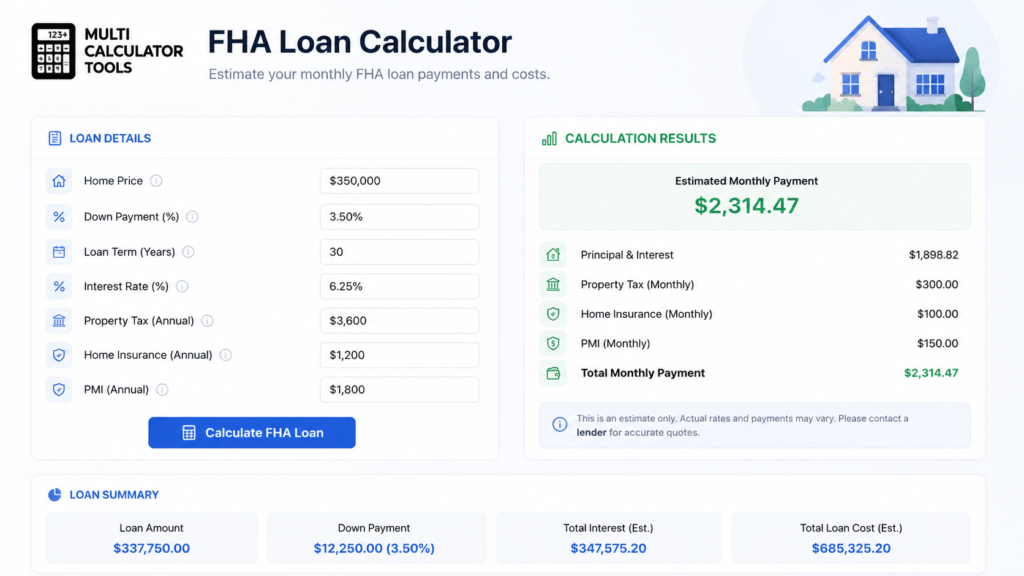
The Federal Housing Administration loan calculator is a tool that helps you figure out what your monthly mortgage payment will be for a Federal Housing Administration loan. This includes the amount, the interest, the mortgage insurance, the taxes and the insurance. It is really important to get an estimate of this payment because Federal Housing Administration loans have some extra costs that other loans do not have. For example you have to pay for mortgage insurance every year. You also have to pay a big fee upfront. These costs can make a difference in how much you pay every month.
The Federal Housing Administration loan calculator is very useful for people who are buying a home for the time for people who are currently applying for a Federal Housing Administration loan for homeowners who are looking at different options for refinancing their loan and for real estate agents and mortgage professionals who are helping their clients plan to buy a home. Below this you can learn more, about how the Federal Housing Administration loan paymentsre calculated and what things can affect how much you pay. You can also learn how to use the Federal Housing Administration loan calculator to get an idea of what your monthly payment will be. You can use the calculator above to get your numbers now and see what your monthly Federal Housing Administration loan payment will be.
Quick Answer Box
An FHA loan calculator estimates your monthly FHA mortgage payment by combining principal and interest, upfront and annual mortgage insurance premiums (UFMIP and MIP), property taxes, homeowners insurance, and HOA fees. It helps home buyers understand the full cost of an FHA-backed loan before applying.
What Is an FHA Loan Calculator?
An FHA loan calculator is a tool that estimates your total monthly FHA mortgage payment based on your home price, down payment, interest rate, loan term, and FHA-specific mortgage insurance costs. It gives buyers a clearer picture of affordability than a basic mortgage calculator alone.
FHA loans differ from conventional loans mainly through their mortgage insurance structure and more flexible qualifying guidelines. FHA loans are insured by the Federal Housing Administration, allow down payments as low as 3.5% for qualifying borrowers, and require both an upfront mortgage insurance premium and an ongoing annual premium — costs that conventional loans handle differently.
Getting an accurate FHA payment estimate matters because mortgage insurance can add a meaningful amount to your monthly bill, and it may last for the life of the loan depending on your down payment. Factors that affect your estimated payment include home price, down payment size, interest rate, loan term, mortgage insurance rates, property taxes, homeowners insurance, and HOA fees.
Keep in mind that any calculator estimate has limitations: it can’t account for individual lender pricing, your final credit approval, or fees specific to your transaction. It’s a planning tool, not a loan offer, and responsible borrowing decisions should factor in your full budget, not just the estimated payment.
How Does the FHA Loan Calculator Work?
The calculator works by taking your home purchase price and down payment to determine your base loan amount, then applying your interest rate and loan term to calculate principal and interest, before adding FHA mortgage insurance, taxes, insurance, and any HOA fees to produce a total estimated monthly payment.
Here’s what each input does:
- Home purchase price – The total price of the home you plan to buy.
- Down payment – The amount paid upfront, which reduces your loan balance. FHA loans allow as little as 3.5% down for qualifying borrowers with a 580+ credit score.
- FHA loan amount – Your purchase price minus your down payment, which forms the base amount your mortgage insurance and interest are calculated on.
- Interest rate – The rate charged on your loan, which directly affects your principal and interest payment.
- Loan term – Typically 15 or 30 years; longer terms lower monthly payments but increase total interest paid over time.
- Monthly principal and interest – The core mortgage payment covering the loan balance and interest charges.
- Upfront Mortgage Insurance Premium (UFMIP) – A one-time fee, currently 1.75% of the base loan amount, usually financed into the loan rather than paid in cash at closing.
- Annual Mortgage Insurance Premium (MIP) – An ongoing premium, generally around 0.55% of the loan balance for most 30-year FHA borrowers, divided into monthly installments and added to your payment.
- Property taxes – Estimated local property tax, often collected monthly through an escrow account.
- Homeowners insurance – Required insurance protecting the home, also frequently escrowed.
- HOA fees – Homeowners association dues, if applicable, added on top of your mortgage payment (not part of the loan itself).
The output shows your estimated total monthly payment, broken down by principal and interest, mortgage insurance, taxes, insurance, and HOA fees, so you can see exactly where your money is going.
How to Use the FHA Loan Calculator
- Enter the home’s purchase price.
- Enter your down payment amount or percentage.
- Select your mortgage interest rate.
- Choose your loan term.
- Enter estimated property taxes.
- Add homeowners insurance.
- Include HOA fees if applicable.
- Review mortgage insurance costs.
- Click Calculate.
- Review your estimated FHA monthly payment.
Factors That Affect FHA Loan Payments
| Factor | Impact on Monthly Payment | Example |
| Home Price | Higher prices increase your loan amount and monthly payment | $250,000 vs. $350,000 home |
| Down Payment | A larger down payment reduces the loan amount and monthly cost | 3.5% down vs. 10% down |
| Interest Rate | Higher rates increase principal and interest payments | 6% vs. 7% interest rate |
| Loan Term | Shorter terms increase monthly payments but reduce total interest | 15-year vs. 30-year loan |
| UFMIP | A one-time 1.75% fee, usually financed, that slightly increases the loan balance | $5,250 on a $300,000 loan |
| Annual MIP | An ongoing premium added monthly, typically around 0.55% of the loan balance | About $137/month on a $300,000 loan |
| Property Taxes | Higher local tax rates increase the total monthly payment | Varies significantly by county |
| Homeowners Insurance | Higher premiums increase the escrowed monthly amount | Coastal vs. inland property |
| HOA Fees | Added directly to the total monthly housing cost | $0 vs. $250/month HOA |
| Credit Score | Affects interest rate eligibility, which impacts the payment | 580 vs. 700+ credit score |
Benefits of Using an FHA Loan Calculator
- Budget planning – See a realistic monthly payment before house hunting.
- Understanding FHA loan costs – Break down principal, interest, mortgage insurance, taxes, and insurance separately.
- Estimating monthly payments – Get a clear number to compare against your income and expenses.
- Comparing loan scenarios – Test different down payments, rates, and terms.
- Preparing for mortgage approval – Understand roughly what a lender may consider affordable.
- Planning down payments – See how increasing your down payment affects your monthly cost.
- Better financial decisions – Make an informed choice before committing to a purchase.
- Faster home-buying preparation – Narrow your price range before working with a lender or agent.
Limitations of FHA Loan Calculators
FHA loan calculators provide a helpful starting estimate, but they can’t capture every detail of your actual transaction. Limitations include:
- Individual lender requirements – Rates, fees, and underwriting standards vary by lender.
- Credit approval – Your actual rate and eligibility depend on full credit and income review.
- Current FHA loan limits – Maximum loan amounts vary by county and change annually.
- Interest rate changes – Market rates shift daily and may differ from your estimate.
- Closing costs – Title fees, appraisal fees, and other closing costs aren’t always included.
- Property appraisal – The home must appraise at or above the purchase price for FHA financing.
- Loan origination fees – Lender-specific fees can add to your upfront costs.
- Future insurance premium changes – MIP rates and rules can change over time.
- Local taxes – Property tax rates vary widely and may differ from the estimate used.
- Utility and maintenance expenses – Ongoing homeownership costs aren’t part of the mortgage payment estimate.
Treat this calculator as a planning tool, not a loan approval or final quote. Consult a qualified mortgage professional before making a home-buying decision.
Mortage Insurance Premium
Paying a bigger down payment of 20% or more if you can usually helps you qualify for rates. So a down payment will generally mean you pay less interest on borrowed money. For loans paying at least 20% down when buying a home gets rid of the need for Private Mortgage Insurance (PMI) payments. These are monthly fees that add up over time.
- One risk of making a down payment is a recession. If theres a recession the home value will likely go down. With it the return on investment of the bigger down payment.
Making a down payment has its benefits too. The obvious one is a smaller amount due when you close.
There are different opportunity costs when you use funds for a down payment.
The money used for a payment can’t be used to:
- Make home improvements to raise the homes value
- Pay off high-interest debt
- Save for retirement
- Save for an emergency fund
- Invest for a chance at a return
To qualify the FHA charges a single upfront mortgage insurance payment (MIP) and annual mortgage insurance premiums.
These mortgage insurance payments from borrowers are required to protect lenders from losses if borrowers default on loans.
The upfront MIP is the same for everyone, which’s 1.75% of the loan amounts and can be financed into the mortgage loans.
The annual MIP varies based on the loan term, loan amount and loan-, to-value (LTV) ratio.
If a borrower makes a payment of 10% or more (LTV ≤ 90%) the annual MIP can be canceled after 11 years.
Otherwise the annual MIP stays in effect for the life of the loan.
Use the tables to figure out the proper MIP rates.
Practical FHA Loan Examples
First-time home buyer using the 3.5% minimum down payment: A buyer purchasing a $300,000 home with 3.5% down ($10,500) finances a base loan of $289,500, plus a 1.75% UFMIP added to the balance, along with monthly principal, interest, and annual MIP.
Buyer with a higher down payment: A buyer putting 10% down on the same $300,000 home reduces their loan amount and may see mortgage insurance drop off after 11 years, rather than lasting for the full loan term.
Buyer purchasing a lower-priced home: A buyer purchasing a $180,000 home has a smaller loan amount, resulting in lower principal, interest, and mortgage insurance costs relative to a higher-priced purchase.
Borrower with higher property taxes: A borrower in a county with high property tax rates sees a noticeably larger monthly payment even though their loan amount and interest rate are unchanged.
FHA borrower with HOA fees: A condo buyer with a $200/month HOA fee adds this cost directly on top of their mortgage payment, increasing their total monthly housing expense.
Buyer comparing 15-year vs. 30-year FHA loans: A buyer comparing loan terms sees a higher monthly payment with a 15-year term but significantly less total interest paid over the life of the loan compared to a 30-year term.
Tips to Lower Your FHA Mortgage Payment
- Save a larger down payment to reduce your loan amount and potentially shorten how long you pay mortgage insurance.
- Improve your credit score before applying, which can help you qualify for a better interest rate.
- Compare FHA-approved lenders, since rates and fees vary between institutions.
- Shop for lower interest rates, since even small rate differences affect your payment over time.
- Reduce existing debt to improve your debt-to-income ratio before applying.
- Choose an appropriate loan term based on your budget and long-term financial goals.
- Budget for taxes and insurance early so there are no surprises in your total monthly payment.
- Understand FHA mortgage insurance costs, including how UFMIP and annual MIP are calculated and how long they last.
Frequently Asked Questions
What is an FHA Loan Calculator?
It’s a tool that estimates your monthly FHA mortgage payment by combining principal, interest, mortgage insurance (UFMIP and MIP), property taxes, homeowners insurance, and HOA fees, giving you a realistic picture of total housing costs before applying for a loan.
How accurate is an FHA Loan Calculator?
It provides a reasonable estimate based on the numbers you enter, but your actual payment depends on your lender’s rate, final loan terms, credit approval, and local tax and insurance costs, which can differ from calculator assumptions.
What is the minimum down payment for an FHA loan?
The minimum down payment is generally 3.5% of the purchase price for borrowers with a credit score of 580 or higher. Borrowers with lower credit scores may need to put down at least 10%, depending on lender requirements.
Does an FHA loan require mortgage insurance?
Yes. All FHA loans require both an upfront mortgage insurance premium (UFMIP) and an annual mortgage insurance premium (MIP), regardless of your down payment amount or credit score.
What is UFMIP?
UFMIP stands for Upfront Mortgage Insurance Premium, a one-time fee currently equal to 1.75% of your base loan amount. It’s typically financed into your loan balance rather than paid in cash at closing.
What is annual MIP?
Annual MIP is an ongoing mortgage insurance premium, generally around 0.55% of your loan balance for most 30-year FHA loans, divided into 12 monthly installments and added to your mortgage payment.
How does my credit score affect an FHA loan?
Your credit score affects your minimum down payment requirement and the interest rate lenders may offer. Generally, a 580+ score qualifies for 3.5% down, while lower scores may require a larger down payment.
Can I remove FHA mortgage insurance?
If your down payment was 10% or more, MIP can typically be removed after 11 years. If your down payment was less than 10%, MIP generally remains for the life of the loan unless you refinance into a different loan type.
What is the maximum FHA loan amount?
FHA loan limits vary by county and are updated annually, with a national floor and ceiling for standard areas and higher limits in high-cost counties. Check your specific county’s current limit before setting a target home price.
Are property taxes included in FHA payments?
Yes. Property taxes are typically collected monthly through an escrow account and included as part of your total FHA mortgage payment, along with homeowners insurance.
Can I use an FHA loan for investment property?
Generally, no. FHA loans are intended for primary residences. Investment or rental properties typically don’t qualify unless the borrower also occupies part of the property, such as in a multi-unit home.
How is an FHA loan different from a conventional loan?
FHA loans allow lower down payments and more flexible credit requirements but require both upfront and annual mortgage insurance regardless of down payment size. Conventional loans may avoid mortgage insurance entirely with 20% down.
Conclusion
Estimating your FHA mortgage payment before house hunting helps you set a realistic budget and avoid surprises during the home-buying process. By understanding how your down payment, interest rate, loan term, and mortgage insurance costs combine, you can compare scenarios with confidence. Use the FHA Loan Calculator above to estimate your monthly payment, and explore our related mortgage and home-buying tools to plan your next steps.