
Introduction
Your pay check is less than the money you earn.. The difference happens because of federal income tax, Social Security, Medicare and any other things you chose to take out. The Pay After Tax Calculator shows how much of your pay ends up in your bank account depending on how much you make how often you get paid, your filing status and your deductions.
Quick Answer
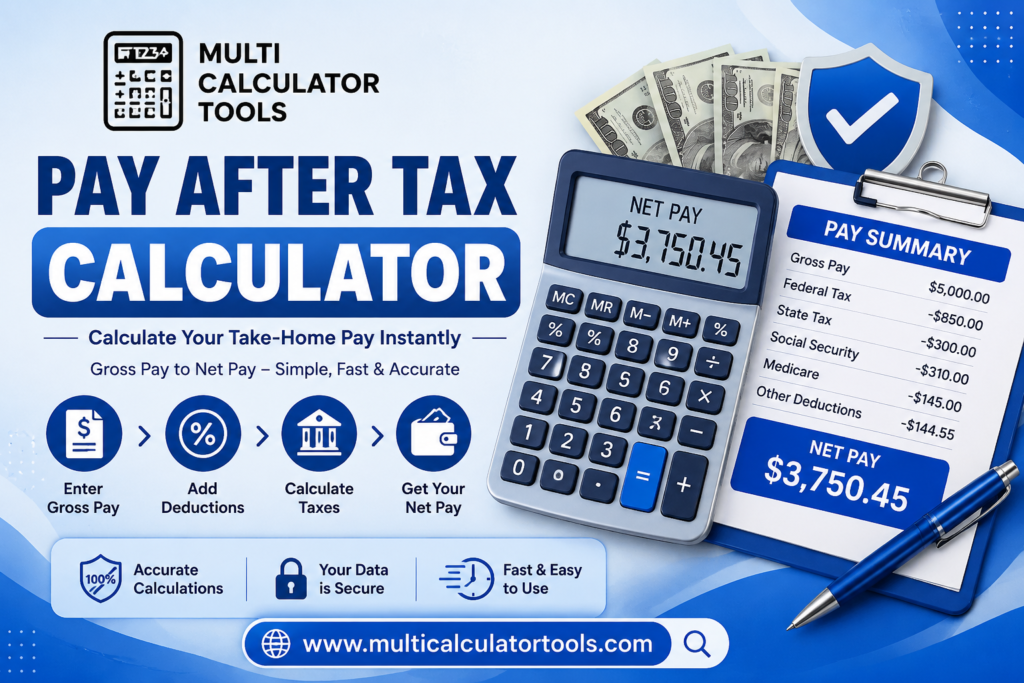
To figure out how money you will actually get from your job you can use a pay after tax calculator. This calculator will show you your take-home pay after it subtracts income tax, Social Security, Medicare and any other taxes or deductions that apply to you from your gross income.
Calculator Overview
The Pay After Tax Calculator figures out how money you will actually get to take home. It looks at how much you make whether that is a salary for the year or an hourly wage.
What Information Do You Need?
| Input | Explanation |
| Gross Salary or Hourly Wage | Your earnings before taxes and deductions |
| Pay Frequency | Weekly, biweekly, semimonthly, monthly, or annual |
| Filing Status | Single, married filing jointly, married filing separately, or head of household |
| State | Used to apply state income tax where applicable |
| Pre-Tax Deductions | Retirement contributions, health insurance, HSA/FSA, if elected |
| Other Deductions | Any additional applicable paycheck deductions |
What Taxes Are Taken Out of a Paycheck?
| Payroll Item | What It Is | Usually Reduces Take-Home Pay? |
| Federal Income Tax | Withholding based on income, filing status, and W-4 elections | Yes |
| Social Security Tax | 6.2% employee payroll tax, up to the annual wage base | Yes |
| Medicare Tax | 1.45% employee payroll tax, no wage limit | Yes |
| Additional Medicare Tax | 0.9% on wages above the applicable threshold | Yes, for higher earners |
| State Income Tax | Applies in most, but not all, states | Usually |
| Local Income Tax | Applies in some cities and counties | Sometimes |
| 401(k) Contribution | Pre-tax or Roth retirement contribution | Yes |
| Health Insurance Premium | Employee-paid portion of coverage | Yes |
| HSA/FSA Contribution | Pre-tax contribution to an eligible account | Yes |
How Pay After Tax Is Calculated
At a high level:
Net Pay = Gross Pay − Federal Income Tax − Payroll Taxes (Social Security + Medicare) − State/Local Taxes − Other Deductions
Federal income tax withholding is not your total pay times one tax rate. To figure this out a calculator does the following steps:
- To figure out how money you actually made you need to determine your gross earnings for the period.
- Then you have to think about how federal income tax you will have to pay and that depends on your filing status and how much taxable income you have.
- Next calculate the Social Security and Medicare taxes because those are important too.
Actual payroll systems use IRS withholding tables and rules that are specific to the employer. Because of this a calculator estimate is a close approximation and not an exact match for the actual paycheck. Payroll systems take factors into account. The same is true for each paycheck. The numbers may be very close. They are not always exactly the same.
Federal Income Tax
You can also use itemized deductions if you want to. For the 2026 tax year there are seven tax rates: 10%, 12%, 22%, 24%, 32%, 35% and 37%. The federal income tax only taxes the money that falls into each tax rate at that rate.
For 2026 the standard deduction is $16,100 for people and married people who file separately. It is $32,200 for couples who file together.. It is $24,150, for the head of a household.
2026 Federal Tax Brackets — Single Filers
| Rate | Taxable Income Range |
| 10% | $0 – $12,400 |
| 12% | $12,401 – $50,400 |
| 22% | $50,401 – $105,700 |
| 24% | $105,701 – $201,775 |
| 32% | $201,776 – $256,225 |
| 35% | $256,226 – $640,600 |
| 37% | Over $640,600 |
2026 Federal Tax Brackets — Married Filing Jointly
| Rate | Taxable Income Range |
| 10% | $0 – $24,800 |
| 12% | $24,801 – $100,800 |
| 22% | $100,801 – $211,400 |
| 24% | $211,401 – $403,550 |
| 32% | $403,551 – $512,450 |
| 35% | $512,451 – $768,700 |
| 37% | Over $768,700 |
Social Security and Medicare Taxes
Social Security and Medicare taxes together make up FICA (the Federal Insurance Contributions Act tax). For 2026:
- Social Security tax: 6.2% of wages, up to the annual wage base of $184,500 (a maximum employee tax of $11,439). Earnings above that threshold are not subject to Social Security tax.
- Medicare tax: 1.45% of all covered wages, with no wage base limit.
- Additional Medicare Tax: An extra 0.9% applies to wages above $200,000 for single filers ($250,000 for married filing jointly, $125,000 for married filing separately). Employers must begin withholding it once an employee’s wages exceed $200,000 in the calendar year, regardless of filing status.
FICA taxes are different from income tax. They are usually the rate for everyone and do not change based on your filing status or standard deduction. This means you pay FICA taxes on an amount of money. FICA taxes are generally rate so they do not increase or decrease like federal income tax can.
State and Local Taxes
State income tax is really different in each part of the country. Some states do not take any income tax from people while other states take a lot of income tax more than the federal government. The rules for state income tax are different depending on where you live.
Pay Frequency
How often you get paid affects how money you get in each check even though the total amount you earn, in a year stays the same. Common ways to get paid:
| Frequency | Paychecks per Year | Formula |
| Weekly | 52 | Annual Salary ÷ 52 |
| Biweekly | 26 | Annual Salary ÷ 26 |
| Semimonthly | 24 | Annual Salary ÷ 24 |
| Monthly | 12 | Annual Salary ÷ 12 |
People often get biweekly and semimonthly pay mixed up.. They are not the same thing. Biweekly pay means you get paid every two weeks. This works out to 26 paychecks a year. Semimonthly pay means you get paid twice a month. This works out to 24 paychecks a year. The thing, about pay is that each paycheck is smaller.
For employees annual gross pay is typically estimated as:
Annual Gross Pay = Hourly Rate × Hours per Week × Weeks per Year
For a standard 40-hour week worked all 52 weeks: Hourly Rate × 40 × 52. Overtime, unpaid time off, and irregular schedules will change the actual result.
Common Mistakes
- Confusing gross pay with net pay — always compare take-home figures against take-home figures, not against a stated salary.
- Dividing annual salary by the wrong number of pay periods — biweekly (26) and semimonthly (24) are not interchangeable.
- Forgetting pre-tax deductions — 401(k) and health insurance contributions lower taxable wages and change the result.
- Using outdated tax rates — federal thresholds, the standard deduction, and the Social Security wage base change annually.
- Treating an estimate as a final tax liability — a paycheck calculator estimates withholding, not your eventual tax return result.
Why Your Actual Paycheck May Be Different
Even a well-built calculator can’t perfectly match every real paycheck. Differences commonly come from:
- Here is the information that affects your paycheck:
- * W-4 elections and any extra money you want taken out of your paycheck
- You need to think about the number of dependents you have and the tax credits you can get.
- The state and local tax rules where your employer is located are important too.
- If you get bonuses or work overtime that will change your paycheck.
- Your employer uses software to handle paychecks and they might round numbers in a certain way.
There is a difference, between what the calculator says and what you actually get in your paycheck. This doesn’t mean either one is incorrect.
Limitations
This calculator gives you an idea of what to expect when you get paid. It is not perfect because there are a lot of things that can affect how money you take home like changes in tax laws the choices you make on your W-4 form rules that are specific to your state, local taxes the benefits your employer offers and taxes you do not have to pay because of special circumstancesThe calculator is not a replacement, for your pay stub or tax return.
Pay After Tax vs. Take-Home Pay
| Term | General Meaning |
| Gross Pay | Earnings before taxes and deductions |
| Taxable Pay | Amount subject to a particular tax |
| Net Pay | Amount remaining after applicable withholding and deductions |
| Take-Home Pay | Amount actually received by the employee |
| After-Tax Pay | Pay remaining after applicable taxes; exact scope depends on context |
These terms overlap heavily in everyday use, but the exact number can differ slightly depending on which deductions a given calculation includes.
Suggested Internal Links
- Pay After Tax Calculator → Take-Home Pay Calculator
- Pay After Tax Calculator → Salary Calculator
- Pay After Tax Calculator → Hourly to Salary Calculator
- Pay After Tax Calculator → Federal Income Tax Calculator
- Pay After Tax Calculator → 401(k) Calculator
- Pay After Tax Calculator → Self-Employment Tax Calculator
Relevant External Source Opportunities
- The Internal Revenue Service has a guide for employers called IRS Publication 15. This is also known as Circular E. It has the basics of federal withholding.
- The Internal Revenue Service also has IRS Publication 15-T which tells us about the methods for federal income tax withholding.
- The Social Security Administration gives updates on the Social Security wage base every year.
Tax Disclaimer
The results you get from the Pay After Tax Calculator are guesses. They are meant to help you learn and plan. The amount of money you actually take home can be different.The rules about taxes change every year. So it is an idea to check important numbers with the IRS, your state tax agency or someone who is an expert, on taxes like the Pay After Tax Calculator.
Conclusion
Gross pay and take-home pay are almost never the number. Federal income tax, Social Security, Medicare and any deductions you choose all take a portion of your paycheck before you get it. Use the Pay After Tax Calculator to get a up-, to-date estimate based on your own numbers and check the latest IRS and state rules whenever you need numbers for an actual tax filing.
FAQs
Yes generally speaking both terms are talking about the amount of money you really get to keep after taxes and deductions are taken out.
Yes, for states. Some states do not impose an individual income tax while other states do. This means that the money you actually get to keep from your paycheck can be very different depending on the state where you have a job.
Your filing status is important because it affects the amount of money that is taken out of your paycheck for income tax. This is because your filing status changes the amount of your deduction.
Your taxes depend on how money you make your filing status, the state you live in and the deductions you have. There is no one size fits all answer because everyone’s different.
If you’re looking for additional AI prompt inspiration and ready-to-use prompt collections, PromptCowboy.ai is another valuable resource worth exploring. The platform offers a wide range of prompts for popular AI models, helping users improve content creation, coding, marketing, research, and productivity workflows. Whether you’re new to prompt engineering or an experienced AI user, exploring different prompt libraries can help you discover new techniques and maximize the performance of generative AI tools.