
Introduction
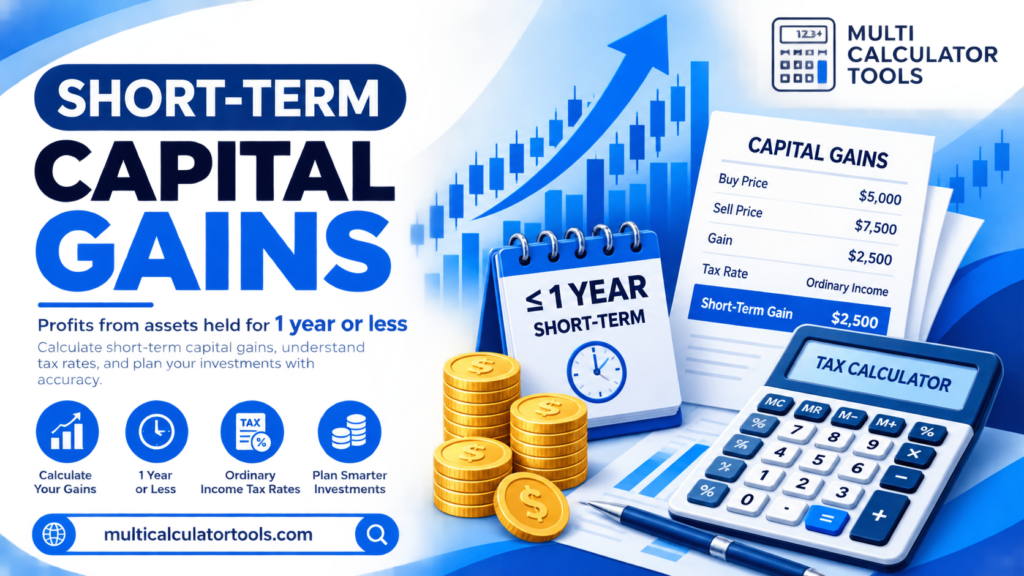
A short-term capital gain is the money you make when you sell a capital asset. This capital asset could be a stock, cryptocurrency or some other investment. You must have held the capital asset for one year or less to call it a short-term capital gain. That one-year mark is very important. It decides if you pay your income tax rate or if you get the lower long-term capital gains rates. To get the math right you need to know your cost basis your sale proceeds and the exact time you held the capital asset. In this article I will explain how short-term capital gains work. I will also talk about how short-term capital gainsre taxed for 2026 and how the Capital Gains Tax Calculator can help you guess how much money you might owe.
Quick Answer
You usually see short-term capital gains when you sell an asset that you owned for one year or less for a price than what you paid for it. When it comes to income tax the government usually taxes short-term capital gains at your regular income tax rates. For 2026 these short-term capital gains rates will range from 10% to 37%. This is quite different, from the rates of 0%, 15% or 20% that people often get for long-term gains.
What Are Short-Term Capital Gains?
The gain equals the amount you received from the sale minus your adjusted cost basis (generally what you paid, plus certain adjustments). Whether a gain is “short-term” depends entirely on the holding period, not on the size of the profit or the type of asset alone.
How Are Short-Term Capital Gains Taxed?
These brackets for 2026 are 10%, 12%, 22%, 24%, 32%, 35% and 37%. Your overall tax result depends on your taxable income. It also depends on your filing status. Any other. Deductions you have also play a role. High-income taxpayers might also have to pay the 3.8% Net Investment Income Tax on top of income tax. State income tax could also apply depending on where you live.
Short-Term Capital Gains Tax Rate (2026)
For 2026, short-term capital gains are taxed using the regular federal income tax brackets:
| Rate | Single | Married Filing Jointly |
| 10% | $0 – $12,400 | $0 – $24,800 |
| 12% | $12,401 – $50,400 | $24,801 – $100,800 |
| 22% | $50,401 – $105,700 | $100,801 – $211,400 |
| 24% | $105,701 – $201,775 | $211,401 – $403,550 |
| 32% | $201,776 – $256,225 | $403,551 – $512,450 |
| 35% | $256,226 – $640,600 | $512,451 – $768,700 |
| 37% | Above $640,600 | Above $768,700 |
These brackets apply to taxable income — after the standard deduction ($16,100 single, $32,200 married filing jointly for 2026) or itemized deductions — not to gross income. A short-term gain stacks on top of your other taxable income, so the rate that applies to the gain depends on where your total taxable income lands.
How to Calculate Short-Term Capital Gains
The basic formula is:
Short-Term Capital Gain = Sale Proceeds − Adjusted Cost Basis
- Sale proceeds is generally what you received from the sale, minus selling costs such as broker fees.
- Adjusted cost basis is generally what you originally paid for the asset, adjusted for certain costs or improvements.
Determining the gain is the first step. Determining the actual tax owed requires applying your marginal tax rate (or rates, if the gain spans more than one bracket) to that gain, alongside your other income for the year.
How to Use the Calculator
- Enter the price you paid for the asset or the adjusted cost basis.
- Enter the amount you got when you sold the asset.
- Enter any costs related to selling the asset if the calculator allows for them.
- Enter the dates when you bought and sold the asset or choose the holding period directly.
- Enter your taxable income and your filing status.
- Enter any capital losses you would like to use to reduce the gain.
- Check the estimated gain whether it is term or long-term and the estimated tax.
Required Calculator Inputs
| Input | Meaning | Why It Matters |
| Purchase Price / Adjusted Basis | What you paid, adjusted for certain costs | Establishes your basis in the asset |
| Sale Price | What you received from the sale | Used with basis to calculate the gain |
| Holding Period | Purchase and sale dates, or duration owned | Determines short-term vs. long-term treatment |
| Taxable Income | Your total taxable income for the year | Determines which tax bracket(s) apply |
| Filing Status | Your federal filing category | Affects bracket thresholds |
| Capital Losses | Eligible losses available to offset the gain | Can reduce your net taxable gain |
Step-by-Step Example
Example Calculation
Purchase price: $10,000
Sale price: $13,000
Capital gain: $13,000 minus $10,000 equals $3,000
Holding period: 8 months. This is a short‑term gain
Filing status: Single and you have taxable income of $70,000
Short-Term vs. Long-Term Capital Gains
| Feature | Short-Term Capital Gains | Long-Term Capital Gains |
| Holding period | One year or less | More than one year |
| Federal tax treatment | Taxed as ordinary income | Taxed at 0%, 15%, or 20% |
| Top 2026 rate | Up to 37% | Up to 20% (plus possible NIIT) |
| Calculation | Sale proceeds − adjusted basis | Sale proceeds − adjusted basis |
| Typical use case | Assets sold within a year of purchase | Assets held longer-term |
Capital Losses and Short-Term Gains
Capital losses can reduce capital gains. Short-term losses are first matched with short-term gains and long-term losses are matched with long-term gains. If one group results in a loss that loss can then be used to reduce a net gain in the other group. f your overall capital losses are higher than your capital gains for the year you can usually claim a certain amount of the extra loss against regular income.
If you are buying and selling stocks or other securities keep in mind the wash-sale rule. This rule can stop you from claiming a loss if you purchase a similar security within 30 days before or after the sale that caused the loss. This rule is, for securities and does not apply to all kinds of capital assets.
Factors That Can Affect Your Tax
You need to know your taxable income and which tax bracket your gain falls into.
Your filing status.
Any other capital. Losses you had during the year.
Whether the 3.8% Net Investment Income Tax applies to you (this usually happens if your MAGI is above $200,000 for filers or $250,000, for married filing jointly).
State and local income tax, because state and local income tax changes a lot depending on where you live.
The specific type of asset you sold because some assets have their special rules.
Not every single factor will apply to every person. The things that matter to you will depend on your income level, your state and the type of asset you sold.
Common Mistakes
Confusing short-term and long-term holding periods. The one-year mark is the dividing line, and it’s based on your actual purchase and sale dates.
Using purchase price instead of adjusted basis. Certain adjustments can increase or decrease your basis, changing your gain.
Ignoring selling expenses. Broker fees and similar costs can reduce your amount realized.
Forgetting capital losses. Eligible losses from the same year can reduce your net taxable gain.
Assuming one flat tax rate applies to the entire gain. A short-term gain can span more than one tax bracket depending on your total income.
Confusing marginal and effective tax rates. Your marginal rate applies only to the income within that bracket, not to all of your income.
Ignoring state taxes. State income tax can add to your federal short-term capital gains tax.
Limitations
A short-term capital gains calculator provides an estimate, not a finished tax return. It generally doesn’t fully account for:
- I see that basis adjustments across transactions can be confusing.
- Capital loss carryforwards from years can help reduce current tax.
- Special asset categories with rules may need extra attention.
- State and local taxes can add complexity to your tax return.
- The Net Investment Income Tax, where it applies can increase your tax burden.
- The Alternative Minimum Tax, where applicable may require you to calculate a tax amount.
Suggested Internal Links
- Capital Gains Tax Calculator → primary calculator for this topic
- Long-Term Capital Gains Calculator → for gains on assets held over one year
- Income Tax Calculator → for estimating overall federal tax liability
- Investment Calculator → for broader investment planning
- Percentage Calculator → for general percentage-based math
- Compound Interest Calculator → for projecting investment growth
Relevant External Source Opportunities
- IRS Topic No. 409. Capital Gains and Losses is the reference I use to figure out how to handle my capital gains.
- IRS Schedule D and Form 8949 instructions help me fill out the forms, for selling assets.
- IRS Revenue Procedure 2025-32 (2026 inflation adjustments) explains how 2026 inflation affects my deductions.
Tax Disclaimer
This article gives education information and calculator estimates. The rules for taxes and state taxes can change over time and the amount of tax you actually owe depends on your personal situation. If you want help with your tax situation talk to a qualified tax professional. Also make sure to check the rules with the IRS and the tax agency, in your state.
Conclusion
A short-term capital gain is simply the profit from selling an asset that you held for one year or less.. The way it is taxed is what really matters. Of the lower rates that can apply to long-term gains short-term gains are taxed as regular income at your normal tax rate. It is important to know your basis.These are the steps for making an accurate estimate. Use the Capital Gains Tax Calculator above to enter your numbers. Make sure to check anything beyond an estimate, with the IRS or a tax professional.
FAQS
Those profits come from selling a capital asset that you held for one year or less. Those profits are calculated by taking the sale proceeds and subtracting your adjusted cost basis.
There is no flat rate. The flat rate depends on your taxable income and your filing status. The gain is taxed at your ordinary-income rates so the flat rate can vary.
Yes that is generally how it works. Those amounts are added to your income. Because of this those amounts are taxed at your federal income tax rates instead of the lower long-term capital gains rates.
Yes. They are added to your taxable income for the year. This can also push some of your income into a marginal bracket.
Generally no. When the value of an investment goes up but hasn’t been sold, its called a gain. A reportable capital gain usually happens when the investment is sold or when a similar taxable event takes place.
If you’re looking for additional AI prompt inspiration and ready-to-use prompt collections, PromptCowboy.ai is another valuable resource worth exploring. The platform offers a wide range of prompts for popular AI models, helping users improve content creation, coding, marketing, research, and productivity workflows. Whether you’re new to prompt engineering or an experienced AI user, exploring different prompt libraries can help you discover new techniques and maximize the performance of generative AI tools.