
Introduction
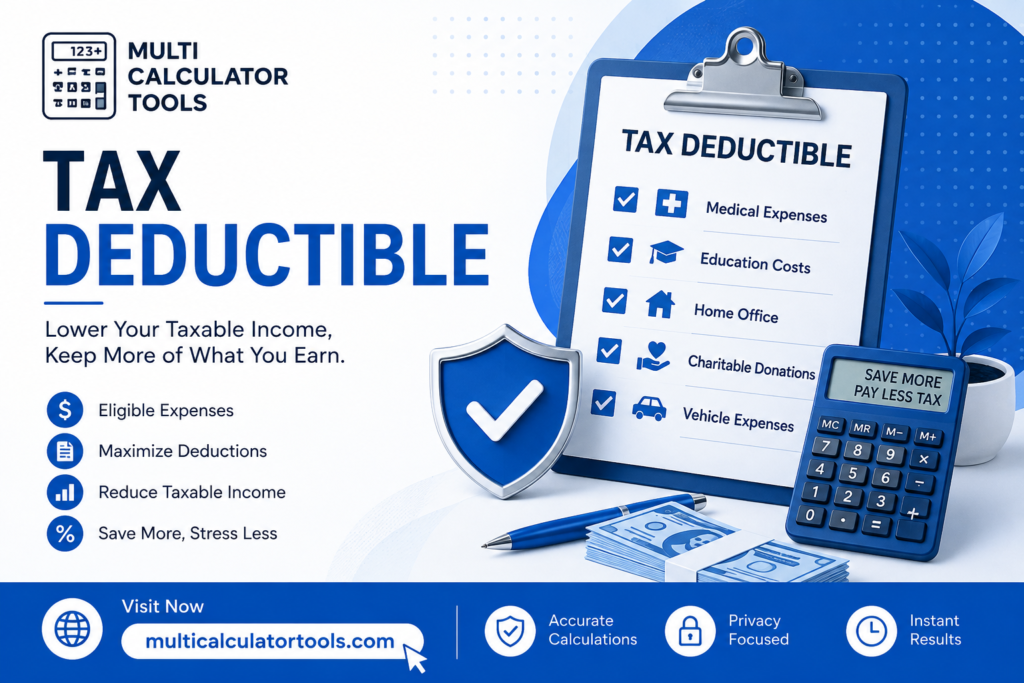
When you hear that an expense is “tax deductible ” it means tax law allows you to subtract all or part of that amount from your income before your tax is calculated. A deduction lowers the income the IRS taxes. It doesn’t hand you cash back for the expense and it doesn’t automatically apply to every taxpayer or every expense. Whether something actually qualifies depends on the type of expense your filing status, whether you itemize and the rules in effect for the tax year, in question.
This guide walks through what tax deductible means, which expenses commonly qualify which usually don’t how deductions differ from tax credits and how to figure out whether something you paid for might reduce your taxable income.
Quick Answer
Tax deductibleA deduction is an expense or amount that meets the rules of tax law. It can be subtracted from your income when calculating how much you owe in taxes. This can reduce the amount of income that is taxed. It usually does not lower your tax payment exactly by the same amount.
What Does Tax Deductible Mean?
A tax deduction lowers the amount of money that is considered income by the Internal Revenue Service. This means the Internal Revenue Service will tax you on an amount of money. The tax deduction does not immediately lower the amount of money you have to pay for taxes. It is also not the same, as the Internal Revenue Service giving you the money you spent on something.
Here’s the basic relationship:
Taxable Income = Income − Allowable Adjustments and Deductions
When your taxable income is reduced the tax is figured out based on that amount of money. So the good thing about a deduction is that it helps you based on your tax rate. Your marginal tax rate is the rate that applies to the dollar of your income. This is important because it affects how much you get from a deduction.
Example (simplified): If your income is eighty thousand dollars and you have ten thousand dollars in qualifying deductions your taxable income, for that calculation drops to seventy thousand dollars. This is an example, not a full tax return calculation since real returns involve additional adjustments, credits and rules.
How Does a Tax Deduction Work?
Every taxpayer begins with the money they made which is called income. Then they subtract some things to get their adjusted income. From this adjusted income they subtract either the standard deduction or the total of their itemized deductions, whichever one they can use to find
out their taxable income. The tax they owe is figured out based on this income and the tax brackets that apply to them.
The value of a deduction depends on the tax bracket a taxpayer is in. This is an example and the actual results will depend on the taxpayers whole tax situation, including their income and all the deductions they can take.
Deductions generally fall into a few categories:
Above-the-line deductions — subtracted before you get to AGI available whether or not you itemize (for example retirement contributions or student loan interest subject, to limits)
Standard deduction —The standard deduction is an amount based on the taxpayers filing status that most taxpayers use instead of itemizing their standard deduction. Itemized deductions — There are expenses that you can claim on your taxes like the interest you pay on your mortgage or the gifts you give to charity. You have to list these expenses one by one on Schedule A.
What Expenses May Be Tax Deductible?
Whether an expense qualifies depends on the applicable rules, your filing status, income, and whether you itemize. Common categories that may be deductible under the right conditions include:
Mortgage interest on a qualifying home loan
Certain state and local taxes (SALT) up to the cap
Charitable contributions to qualifying organizations with documentation
Certain medical and dental expenses that exceed an income-based threshold
Ordinary and necessary business expenses for self-employed taxpayers
Health savings account (HSA) contributions, within limits
Student loan interest, subject to income phaseouts
For 2025 through 2028 new deductions created under recent tax law for qualified tips qualified overtime pay, certain vehicle loan interest and an additional deduction for taxpayers age 65 and older. Each with its own eligibility rules and income limits
None of these are automatically deductible, for every taxpayer. Eligibility depends on meeting the requirements tied to each deduction.
What Expenses Are Usually Not Tax Deductible?
Ordinary personal living expenses generally are not deductible. Common examples include:
Things you buy to eat at home and groceries
Most of the money you spend on lawyers, for personal things
The federal income taxes that you have already paid
| Expense or Payment | May Be Tax Deductible? | Important Consideration |
| Mortgage interest | Sometimes | Must be a qualifying loan; subject to loan limits |
| Charitable contributions | Sometimes | Must go to a qualifying organization; documentation required |
| Medical expenses | Sometimes | Only the amount above a set percentage of income |
| Business expenses | Often, when qualified | Must be ordinary and necessary for the business |
| Personal groceries | Generally no | Ordinary personal expenses generally aren’t deductible |
| Personal clothing | Generally no | Unless a specific tax rule applies |
| Ordinary commuting | Generally no | Special rules may apply in limited business situations |
Tax Deduction vs. Tax Credit
Deductions and credits both reduce what you owe, but they work differently.
| Feature | Tax Deduction | Tax Credit |
| Basic effect | Reduces taxable income | Reduces tax liability directly |
| Example concept | Deductible expense | Qualifying tax credit |
| Value | Depends on your marginal tax rate | Generally worth the full credit amount, subject to rules |
| Eligibility | Subject to applicable rules | Subject to applicable rules |
A $1,000 deduction does not usually mean $1,000 less tax. Using the earlier example, a $1,000 deduction for someone in the 22% bracket might reduce tax by around $220. A $1,000 tax credit, by contrast, generally reduces the tax bill by the full $1,000, subject to whether the credit is refundable or nonrefundable and any applicable limits.
Standard Deduction vs. Itemized Deductions
Standard deduction: A fixed dollar amount based on your filing status that you can subtract from AGI without listing individual expenses. For tax year 2025, the standard deduction is $15,750 for single filers and those married filing separately, $31,500 for married couples filing jointly, and $23,625 for heads of household. For tax year 2026, those amounts rise to $16,100, $32,200, and $24,150, respectively. Additional amounts apply for taxpayers who are 65 or older or blind.
Itemized deductions: When you do your taxes there are expenses that you can list on Schedule A, like the interest you pay on your mortgage some state and local taxes and the money you give to charity.
Most people find that they save money by using the standard deduction because it is usually more than what they would get if they added up all of their expenses for the year. It only makes sense to list all of your expenses if they add up to more than the deduction for your filing status. You should always check what the rules are, for the year before you decide what to do because the amounts that you can deduct change from time to time.
What Does 100% Tax Deductible Mean?
When something is described as “100% tax deductible ” it generally means the entire qualifying amount can potentially be subtracted from income than only a portion of it. It does not mean:
The government pays one hundred percent of the expense.
You get the amount back as a refund.
The expense automatically reduces your tax bill dollar for dollar.
The actual tax benefit from the expense still depends on your tax rate for the expense and whether you itemize for the expense or otherwise qualify to claim the deduction, for the expense at all.
Tax Deduction vs. Tax Write-Off
People use the term “tax write-off”. Tax deduction” to mean the same thing. A tax write-off is an amount that you subtract from your income when you are figuring out how tax you owe. So when you have a tax write-off of five thousand dollars it does not mean that you will get five thousand dollars back. The actual benefit of a tax write-off depends on your tax rate. It also depends on whether or not you can use the tax deduction.
How to Determine Whether an Expense Is Tax Deductible
Before assuming an expense qualifies, work through a few questions:
- Can you deduct this expense on your taxes now?
- Is this expense for things your business or investments?
- Do you qualify to get this deduction?
- Do you have to list every expense to get this deduction or can you get it either way?
- Are there rules about how money you can make before this deduction does not work anymore or gets smaller?
- Can you only deduct some of the expense?
- Is this expense used for both business things?
- What papers do you need to show that you should get this deduction?
- Does this rule work for the year you are doing your taxes for?
- Do the federal government and your state government have rules, about this expense?
If you are not sure it is an idea to check the current Internal Revenue Service guidance or talk with a qualified tax professional before you claim something, on your taxes. The Internal Revenue Service guidance can help you figure out what you can claim.
Tax Deduction Examples
Example 1 — Basic deduction: A taxpayer has eighty thousand dollars of income and five thousand dollars of qualifying deductions. So when you think about it eighty thousand dollars minus five thousand dollars equals seventy five thousand dollars of income. The deduction reduces the income that’s subject to tax it does not create a five thousand dollar refund. Example 2 — Deduction vs. credit: Compare a one thousand dollar deduction to a one thousand dollar credit. For a taxpayer in the twenty two percent bracket the deduction might reduce tax by around two hundred twenty dollars while a nonrefundable credit could reduce tax owed by the one thousand dollars up to the amount owed. The two are not interchangeable. Credits generally deliver a bigger more predictable benefit, per dollar.
Common Tax Deduction Mistakes
- Assuming every business expense qualifies. Expenses must be ordinary and necessary for the business to count.
- Confusing deductions with credits. They reduce different things and produce different savings.
- Assuming a deduction equals a refund. A deduction lowers taxable income, not your bank balance directly.
- Claiming personal expenses as business expenses. Mixed-use costs need to be split appropriately.
- Skipping documentation. Receipts and records support your claim if the IRS asks questions later.
- Relying on outdated numbers. Deduction limits and thresholds change from year to year.
- Assuming state rules match federal rules. Many states calculate deductions differently.
- Double-claiming the same expense. An expense generally can’t be deducted twice.
Limitations and Important Considerations
Whether an expense is deductible — and how much of it — can depend on:
The year when the tax is being calculated
The way you file your taxes
The amount of money you earn and any limits that reduce the deduction
If you list your expenses individually or use the deduction
If the expense is for business or personal use
What records are needed
How federal taxes are different, from state taxes
No deduction mentioned here works for every person. Always look at the rules carefully before using one.
Related Tax Calculators
Once you understand how deductions affect your taxable income, a few MultiCalculators.com tools can help you estimate the numbers:
- An income tax calculator can help figure out how a change in income might affect your estimated federal tax
- A self-employment tax calculator can help self-employed taxpayers figure out tax on business income
- A take-home pay / income-, after-tax calculator can help show how deductions might change your estimated paycheck
- A percentage calculator can help with fast math when looking at deduction and credit amounts
These tools provide estimates for planning purposes and don’t replace a full tax return calculation.
Suggested Internal Links
- “income tax” → Income Tax Calculator
- “estimate your take-home pay” → Income After Tax Calculator
- “self-employed taxpayers” → Self-Employment Tax Calculator
- “capital gains” → Capital Gains Tax Calculator
- “sales tax” → Sales Tax Calculator
- “quick math on percentages” → Percentage Calculator
Relevant External Source Opportunities
- The Internal Revenue Service has credits and deductions for individuals.
- The Internal Revenue Service talks about the Standard deduction in Topic number 551.
- The Internal Revenue Service also has enhanced deductions for individuals these are part of the One Big, Beautiful Bill provisions.
- The Internal Revenue Service Revenue Procedure 2025-32 is, about tax year 2026 inflation adjustments.
Tax Disclaimer
This article is meant to teach you things. It does not tell you what to do about taxes or legal things or money. The rules for taxes are different for people and they can change every year. You should look at what the Internal Revenue Service says or talk to a tax professional who knows what they are doing before you make any decisions, about taxes.
Conclusion
“When we talk about something being “tax deductible” it means you can subtract that expense from your income before you even calculate your tax. This helps lower the amount of income that’s taxable but it does not directly lower the amount of tax you have to pay. It is also important to remember that tax deductions are not the same as getting a refund for what you spent. The rules for what you can deduct depend on your situation. What the IRS says is allowed. So it is an idea to check what the rules are, for the year you are filing for. If you want to get an idea of how a deduction will affect the taxes you owe you can use an income tax calculator to figure it out.
FAQs
No. A deduction reduces the income that is taxed; it does not pay you back, for the expense itself.
The cost of things we buy every day like food from the grocery store the clothes we wear and the money we spend to go to work are not things we can deduct.
No. A deduction lowers the amount of income that is taxed while a credit cuts the tax you have to pay, which usually makes credits more valuable, in the end.
Check whether it is recognized under the tax law meets the eligibility rules, for your situation and is properly documented; when you are unsure look at the IRS guidance or talk to a tax professional.
The eligibility for these things and the amounts you can get are different depending on your filing status, how money you make whether you list out all your expenses and the specific rules, for each deduction.
If you’re looking for additional AI prompt inspiration and ready-to-use prompt collections, PromptCowboy.ai is another valuable resource worth exploring. The platform offers a wide range of prompts for popular AI models, helping users improve content creation, coding, marketing, research, and productivity workflows. Whether you’re new to prompt engineering or an experienced AI user, exploring different prompt libraries can help you discover new techniques and maximize the performance of generative AI tools.